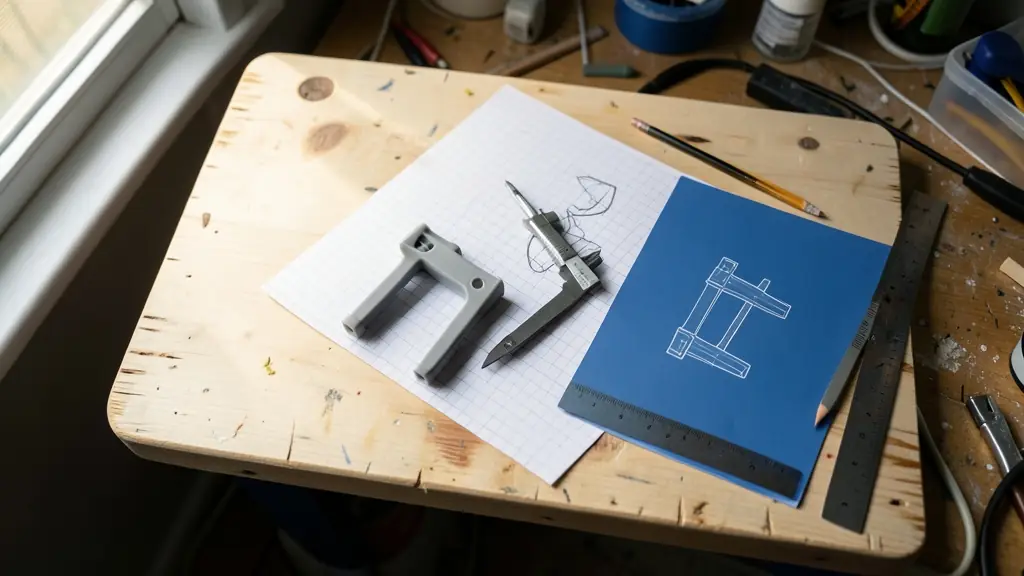
A printer only ever makes what the file tells it to. If the part you need does not exist on a free model site, or the one you found is a millimetre out, someone has to draw it in CAD software. A good designer can work from a pencil sketch on a serviette, a snapped knob from the washing machine with your calliper readings, or three photos of a mounting point. The quality of what you hand over decides how many rounds of drafts you pay for.
What to hand the designer
- Measurements with a calliper, not a tape, to a tenth of a millimetre where it fits into something.
- The broken part itself, posted or dropped off, if it still exists. Photos with a ruler in shot help when it cannot travel.
- What it mates with: a 6 mm shaft, an M4 bolt, a 20 mm PVC pipe, a slot in a cupboard door.
- What it carries: a towel, a pump hose, a gate latch slammed by the wind.
- How you will print it: your own FDM printer, resin, or a bureau using SLS nylon. Each changes the rules.
Odd shapes such as a curved car panel go faster from a scan; see 3D scanning services.
Rules a printable design follows
Walls need to be a few nozzle widths thick, so roughly 1.2 mm or more on a 0.4 mm nozzle. Overhangs steeper than about 45° need supports or a smarter shape, such as a chamfer instead of a flat ledge. Holes print slightly small, so a designer who knows printing draws them a touch oversize.
Moving parts need a clearance, often 0.2 to 0.4 mm on FDM depending on the machine. A designer should also orient the part so layers run the strong way, because a printed hook pulled along its layer lines can split. Ask them to check the size against the bed with the will it fit calculator.
Simple job or complex job: if this, then that
- If it is a spacer, a cover or a cable clip: one draft, often done in an hour or two.
- If it is a replacement with a thread, a snap fit or a hinge: expect a test print and one correction.
- If it carries weight or holds pressure: the design is the easy part, and a qualified engineer has to approve it before use.
- If it is a product you plan to sell: budget for several rounds and read prototyping and production.
Who owns the file
Agree it before work starts. Some designers hand over the STL only and keep the editable STEP; others sell you both. If you will want changes later or a second bureau to print it, ask for the STEP in writing.
Copying a branded part to sell is another matter: ask the rights holder, and do not assume a broken part is free to reproduce commercially. Then send the file to a print bureau.
What to put in your request
- Calliper measurements of the key features
- Photos with a ruler or the broken part itself
- What it fits onto and what it must carry
- The printer or process that will make it
- Whether you want the STEP file as well as STL
3D Modelling and Design for makers, schools, engineers and businesses
- Makers and hobbyists: a lost board game piece, a drone mount or a fix for a cupboard hinge drawn to size
- Schools, colleges and makerspaces: a learner's sketch turned into a printable model for a technology project or robot
- Engineers and product designers: a concept drawn up with proper clearances before the first fit check print
- Small businesses and sellers: a product, display stand or packaging insert drawn ready for a small print run
- Factories, mines and workshops: an obsolete machine cover or guide redrawn from the worn original and measurements
- Dental labs and clinics: aids and holders for a clinic or workshop, drawn to fit, never claimed as approved
- Car owners and panel shops: a clip, cap or pod for an older car redrawn from the cracked original part
- Architects, artists and prop makers: an architect's or artist's idea modelled with walls thick enough to survive printing