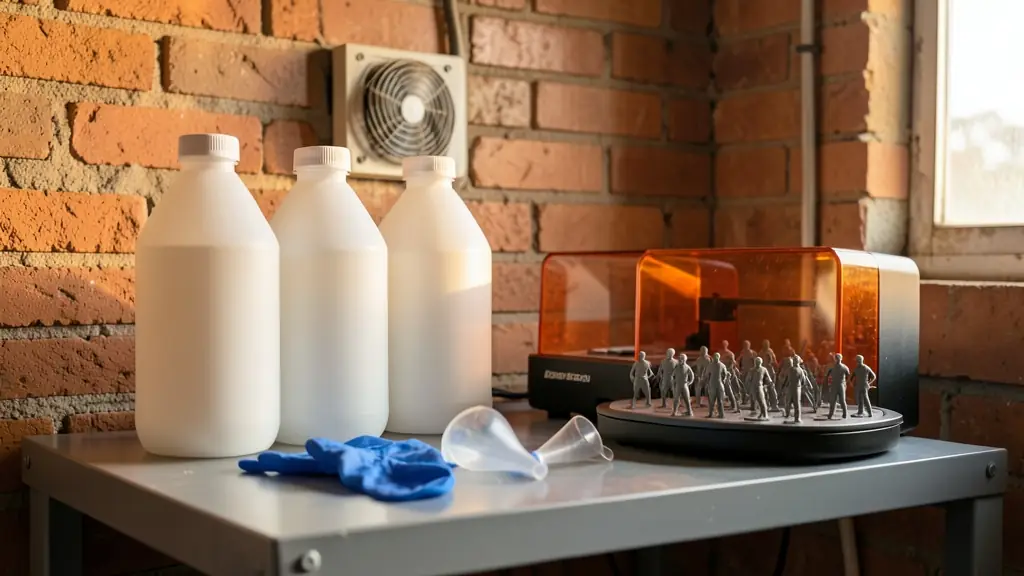
A resin printer is only as good as the liquid you pour into its vat. The same MSLA machine that gives a Bloemfontein gamer crisp miniatures will print brittle, snapping clips if it is fed the wrong bottle, and a jeweller in Durban needs a grade that burns out clean in a flask. This page sorts the common resin families by job, then covers the handling that the bottle's small print expects of you: gloves, air, storage and getting rid of what is left over.
The resin families and what each is for
- Standard resin prints sharp and cheaply, but it is brittle. Display pieces and test prints.
- High detail grey shows fine edges well for painting. Miniatures and busts.
- Tough or ABS like resin bends a little before it breaks. Clips, enclosures, parts that get handled.
- Water washable resin rinses in tap water instead of IPA, though the rinse water still needs curing before it goes anywhere.
- Flexible resin gives rubbery seals and grips, softer than most TPU, and tears more easily.
- Castable resin burns out in a casting flask with little ash. Rings and pendants for lost wax style casting.
- Dental grades for models, trays and guides, used only within the maker's approvals and the clinician's say.
For the machine itself, see resin 3D printers.
Keeping a bottle usable
Resin cures in light, so store it in its own opaque bottle with the cap tight, out of the sun and away from a hot roof space. A cool cupboard is right; a garage that bakes in a Northern Cape summer is not. Pigment settles, so shake the bottle hard before every pour.
Leftover resin in the vat can stay a day or two under the lid if the room is dark. For longer, pour it back through a fine filter so a cured flake does not end up pressing into the FEP film on the next print.
Handling it without regret
Uncured resin is a skin sensitiser: people who handle it bare handed for months can develop an allergy that stays. Wear nitrile gloves every time, plus glasses for pouring and washing. Work in a room with moving air, ideally a window and a fan pulling outward, and keep children, pets and food well away. The bench in the kitchen is the wrong place.
Wipe spills with paper towel, then put that towel in the sun to cure before it goes in the bin. Follow the resin's safety data sheet beyond this.
Leftovers, dirty IPA and supports
- Let cured supports and failed prints harden fully under UV before binning them.
- Leave dirty IPA in a clear jar in the sun; the resin settles out as a solid sludge.
- Decant the clearer IPA for reuse, then cure and bin the sludge.
- Never pour liquid resin or wash fluid down the drain; ask the municipality about anything you cannot cure.
To work out how many bottles a batch of prints needs, run it through the resin calculator.
What to put in your request
- The resin grade: standard, tough, castable
- The colour and how many litres or bottles
- Your printer's light wavelength, often 405 nm
- Whether you want IPA or water washable
- Where to deliver and how soon
3D Printer Resin for makers, schools, engineers and businesses
- Makers and hobbyists: grey resin for painted miniatures, terrain pieces and busts for the tabletop group
- Schools, colleges and makerspaces: small batches of models in water washable resin for a supervised science room
- Engineers and product designers: tough resin for snap fits, small housings and fine detail prototypes
- Small businesses and sellers: figurines, cake toppers and small gifts sold in short runs from one printer
- Factories, mines and workshops: tough or heat tolerant resin for small jigs and inspection gauges
- Dental labs and clinics: dental model and guide resins used within the maker's approvals and the lab's checks
- Car owners and panel shops: small badges and emblem masters for old models, cast or painted afterwards
- Architects, artists and prop makers: castable resin for rings and pendants, and sharp parts for architectural details