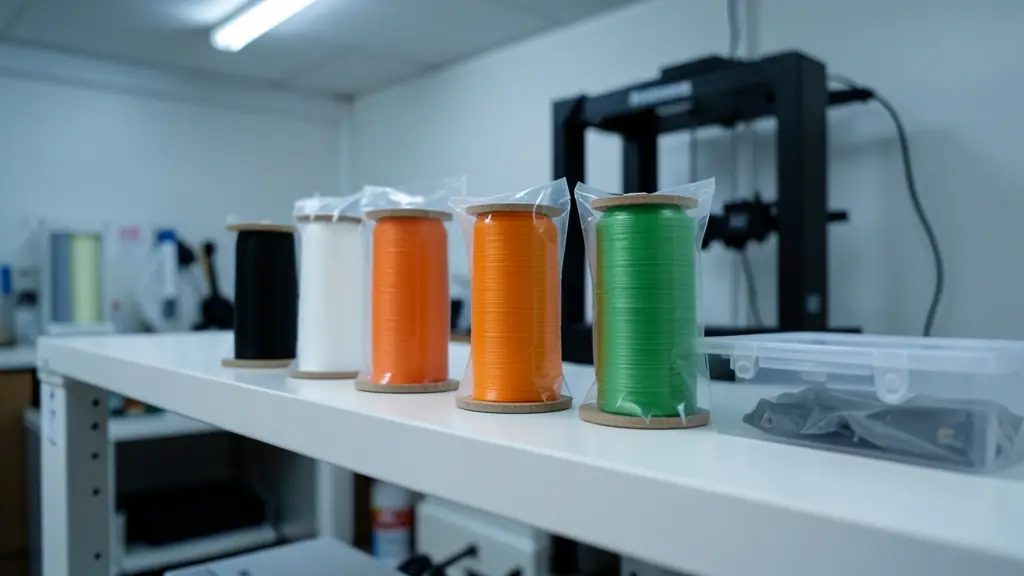
Choose the plastic for the part, and the spool for the printer. Those are two separate decisions, and mixing them up is how people end up with a 2.85 mm spool that will not feed or a gorgeous silk spool for a bracket that snaps. This page covers the spool side: the diameter, the sizes, what the label should tell you, and how to keep filament dry in Durban or Knysna. Each material then has its own page.
Diameter and spool size
Most printers sold today take 1.75 mm filament; some older and a few professional machines take 2.85 mm (often sold as 3 mm). They are not interchangeable, so check the printer's manual before you order.
Spools come in 250 g and 500 g for trials and odd colours, 1 kg as the common size, and 2 to 3 kg or 5 kg for print farms. A big spool costs less per kg but sits open longer, which matters for plastics that drink water. A 1 kg spool of 1.75 mm PLA holds roughly 330 m; the filament length calculator works out the rest.
What a good label tells you
- Material and diameter, with a tolerance such as ±0.02 or ±0.05 mm.
- Net weight of plastic, not counting the reel.
- A nozzle and bed temperature range.
- Drying temperature and time.
- A batch number, so a reorder matches the colour.
No tolerance and no temperatures is a warning sign. The print settings guide fills in typical values.
Which material for which job
- PLA: indoor models, prototypes, first prints.
- PETG: tougher parts that see sun and water.
- ABS and ASA: heat, car interiors, outdoors.
- TPU: flexible gaskets, feet and cases.
- Nylon and carbon fibre: gears, jigs, factory spares.
- Specialty: silk, wood, marble, glow.
- Resin: for MSLA printers, not filament machines.
- Recycled spools: old prints made new.
Storing spools in a humid town
- Leave a new spool sealed until you need it.
- Back in a zip bag or a clip lid tub with desiccant after each print.
- Recharge or replace the desiccant when its colour turns.
- Dry a spool that pops, strings or prints rough. See filament dryers.
- Print nylon and TPU straight from a dry box.
What to put in your request
- The material and the diameter your printer takes
- Colours, and whether they must match a batch
- Spool size and the kilograms you need
- Whether you order once or every month
- Your town, and a delivery date if it matters
3D Printer Filament for makers, schools, engineers and businesses
- Makers and hobbyists: a small rack of PLA and PETG in a few colours for models, fixes and gifts
- Schools, colleges and makerspaces: a term's supply of PLA in classroom colours, ordered once and stored sealed
- Engineers and product designers: PETG and nylon for prototypes that must survive a real fit and function test
- Small businesses and sellers: a print farm's monthly order of 5 kg spools in matched batches
- Factories, mines and workshops: engineering grades kept dry on the shelf for spares a workshop prints on demand
- Dental labs and clinics: PLA and PETG for anatomy models, trays and holders, not for anything in the body
- Car owners and panel shops: ASA and PETG for trims and clips that face heat and sun in a parked car
- Architects, artists and prop makers: silk, matte and wood filled spools for display models, props and décor