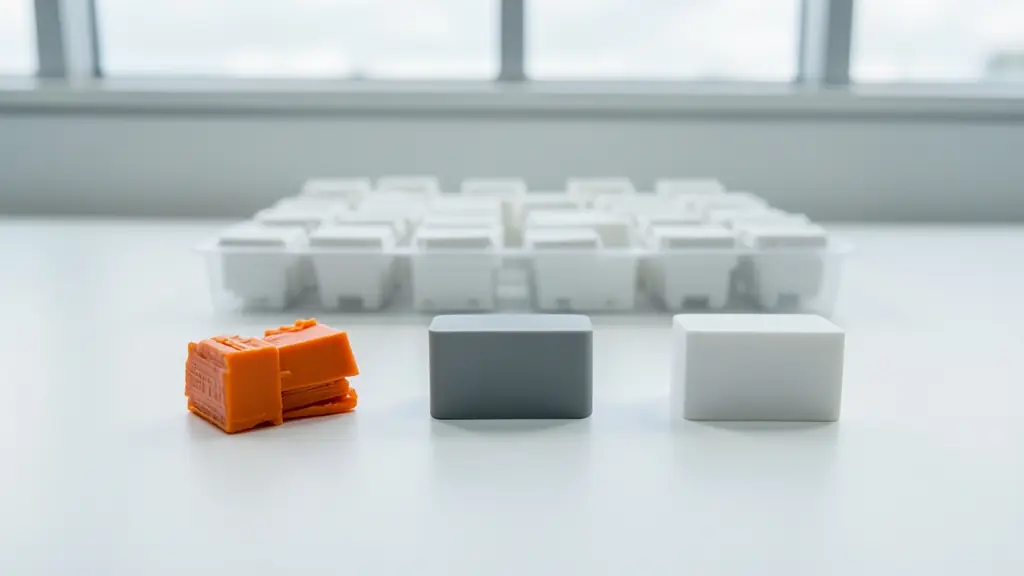
The first print of a new part is never the last. You print it overnight, find the screw boss is in the wrong place, move it, and print again before lunch. That cycle is cheap with printing and painfully slow with tooling. Once the design settles, the same file can turn into 50 parts on a print farm or 500 in SLS nylon, with no mould at all. Knowing where that road ends, and moulding begins, saves money.
Stages and the process each suits
- Look and feel: FDM in PLA, fast and cheap, for size, shape and a meeting on Monday.
- Fit and function: PETG, ASA or nylon on FDM, or tough resin, to test clips, screws and heat.
- Pre production: SLS or MJF nylon (PA12), the same process you would use for the batch, so the tests mean something.
- Small batch: a print farm with many FDM machines, or a bureau filling an SLS build chamber with parts nested in three dimensions.
Compare processes on 3D printing services.
When moulding takes over
An injection mould has a high fixed cost and a low cost per part; printing is the reverse. The crossover depends on the size and shape of the part, so ask a bureau and a toolmaker to quote the same quantity. For many small housings it sits somewhere in the hundreds to low thousands.
Printing also keeps winning when the design will still change, when you need ten variants instead of one, or when a mould's lead time would miss the season. Use the print cost calculator for a feel per part.
Batch problems and their causes
- Parts vary in size: different machines or nozzles on the farm. Ask for one machine type and inspection of the first parts off each.
- Colour shifts halfway: a new filament lot. Ask that one lot is bought for the whole run.
- Holes too tight: tolerance not stated. Put critical dimensions and limits on a drawing.
- Warped long parts: orientation or material. Settle it on the approved sample.
Approve a sample first
Ask the bureau to make a few parts by the exact process, material, colour and orientation of the run, then measure and test them yourself. Sign the approved sample, keep one, and write into the order that the batch must match it. Anything bearing a load needs an engineer's approval, not just yours. If the design itself still needs work, see 3D modelling and design.
What to put in your request
- STEP or STL file, with a drawing of key sizes
- Prototype, sample batch or full run quantity
- Material and colour, and one lot for the run
- Deadline and delivery address
- How the parts will be checked on arrival
Prototyping and Production for makers, schools, engineers and businesses
- Makers and hobbyists: a gadget idea turned into a working model before you spend on anything more
- Schools, colleges and makerspaces: final year design learners testing three versions before the exhibition
- Engineers and product designers: fit checks overnight, then a pre production batch in the real material
- Small businesses and sellers: a short run of a new product to test sales before paying for a mould
- Factories, mines and workshops: jigs, fixtures and replacement guides in batches for several plants
- Dental labs and clinics: device housing prototypes for firms that carry their own approvals
- Car owners and panel shops: a club run of clips or ducts after a single tested sample fits the car
- Architects, artists and prop makers: a batch of display pieces or props that must all match the approved one