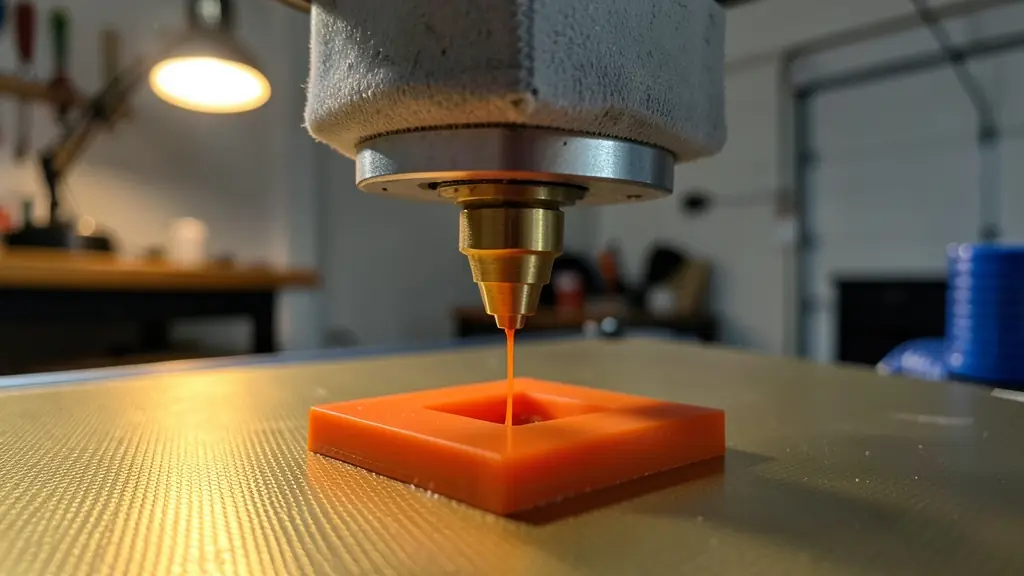
That small piece of brass at the bottom of the hot end decides more about a print than most settings. Swap a 0.4 mm nozzle for a 0.6 and a cosplayer's helmet piece prints in half the time with tougher walls; swap it for a 0.2 and a gamer's lettering on a base turns readable. The metal matters as much as the size, because carbon fibre or glow filament will chew through brass. Here is how to choose one, fit it and know its limits.
Sizes and what each one trades
- 0.2 mm: very fine detail, small text, slow prints and easy to clog.
- 0.4 mm: the standard almost every printer ships with; a fair balance of detail and speed.
- 0.6 mm: stronger, thicker walls and much faster prints, with a slightly coarser look.
- 0.8 mm and up: big parts, vases, jigs, prints on large format printers; detail drops off.
A bigger nozzle also tolerates wood filled and other gritty filaments that would block a fine one.
Brass, stainless, hardened, tipped
Brass conducts heat well and costs little, but wears fast on abrasives. Stainless steel is sometimes chosen for prints near food related uses in general terms, since brass may contain lead; even so, no nozzle makes a print food safe on its own. Hardened steel survives carbon fibre, glass fibre, glow in the dark and metal filled spools, though it needs a little more heat. Tipped nozzles, a brass or copper body with a hard insert at the tip, combine good heat flow with wear resistance.
If you plan to run nylon and carbon fibre filament, fit a hardened or tipped nozzle first.
Changing a nozzle without stripping the block
- Heat the hot end to printing temperature, around 230 °C or what your last material used.
- Hold the heater block still with a spanner so it does not twist on its wires.
- Unscrew the old nozzle with a socket and set it on a heat proof surface.
- Screw the new one in by hand, cold threads first, then snug it while hot. Do not force it.
- Reset the nozzle height or Z offset and print a first layer test.
Check the thread before you buy: most desktop nozzles use M6, but not all, and the length must match your heat break.
Flow, the hidden speed limit
A hot end can only melt so much plastic per second. Push the speed beyond that and the filament comes out half melted, giving weak layers and skipped steps at the extruder. A wider nozzle does not raise this limit on its own; a longer melt zone or a high flow hot end does.
Check what speed your setup really supports with the nozzle flow calculator before chasing quicker prints.
What to put in your request
- Your printer model and hot end type
- The thread, often M6, and nozzle length
- The sizes you want, 0.2 to 0.8 mm
- Brass, hardened steel or a tipped nozzle
- How many of each and where to deliver
3D Printer Nozzles for makers, schools, engineers and businesses
- Makers and hobbyists: a 0.2 mm nozzle for miniature bases and a 0.6 mm for big cosplay pieces
- Schools, colleges and makerspaces: a pack of spare brass nozzles so a learner's clog is a five minute fix
- Engineers and product designers: hardened nozzles for carbon fibre test parts and stiff fixtures
- Small businesses and sellers: 0.6 mm nozzles across a print farm to cut hours on large orders
- Factories, mines and workshops: hardened or tipped nozzles for glass filled nylon spares made on site
- Dental labs and clinics: fine nozzles for small detailed aids and models a clinic or lab uses
- Car owners and panel shops: a 0.6 mm hardened nozzle for tough ducts and brackets in filled filament
- Architects, artists and prop makers: a 0.8 mm nozzle for large signage letters and vases printed in one pass