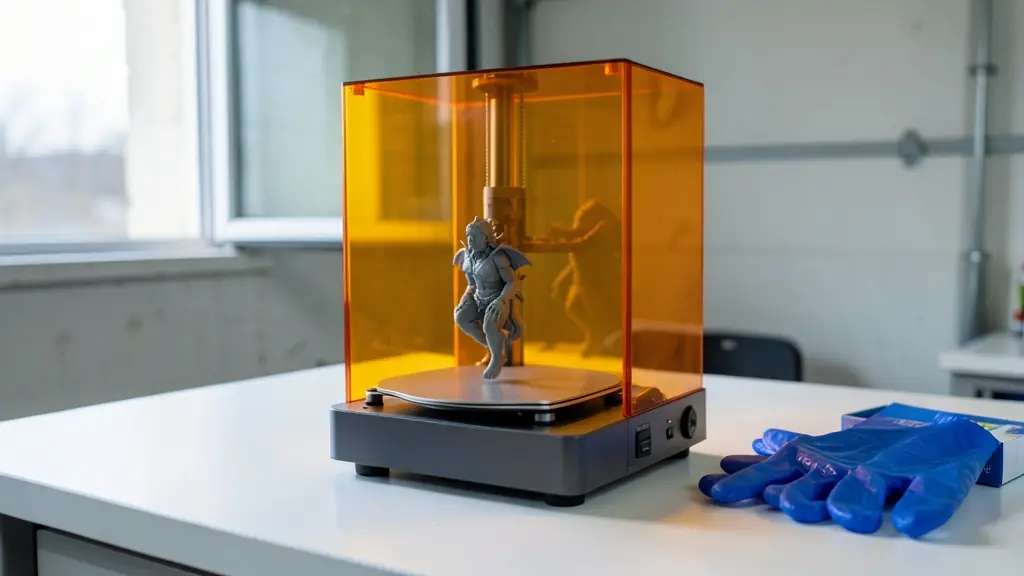
A resin printer builds the part upside down. A build plate dips into a shallow vat of liquid resin, an LCD screen underneath shows the shape of one layer, UV light shines through, and that layer hardens against the plate. Lift, repeat, a few thousand times. The result is detail filament cannot match: eyelashes on a miniature, crisp margins on a dental model, the claws of a ring. The cost is a routine of gloves, washing and curing, and a room that is not the kitchen table.
Inside the machine
- The vat: a shallow tray that holds the resin, with a clear film for a floor.
- The FEP film: the release layer each print peels from. A scratch or puncture lets resin onto the screen, so keep spares.
- The LCD screen: a wear part. UV light ages it, and in time it fades or develops dead lines. Ask what a replacement costs and whether it is stocked here.
- Layer times: every layer cures in the same few seconds, whether there is one part or twenty, so a full plate takes no longer than a single model of the same height.
What resin does best
A tabletop gamer in Bloemfontein can fill a plate with squad figures overnight. A dental lab in Sandton prints models for aligners and crowns; the lab decides what is accurate enough, and any device for the mouth needs the resin maker's registration and the clinician's say. A jeweller in Durban prints castable patterns that burn out cleanly for casting.
For brackets and big housings, filament is cheaper and tougher; see 3D printers for sale. Which resin goes with which job is on 3D printer resin.
The routine after every print
- Put on nitrile gloves and eye protection, and open a window or run an extractor.
- Remove the plate and let excess resin drip back into the vat.
- Wash the parts in IPA, or in water if the resin is water washable.
- Let them dry fully, then cut away supports.
- Cure under UV light for the time the resin's data sheet gives.
- Leave dirty IPA and resin scraps in the sun to harden before disposal, as your municipality allows. Never pour them down the drain.
Symptom and likely cause
- Prints fail on a cold Highveld morning: the resin is too cold and thick; warm the room first.
- A smell that lingers in the house: not enough ventilation, or the printer is in a shared living space.
- Parts stay sticky: under washed or under cured.
- A blob stuck to the film: a failed part; clear it before the next print presses on it.
Plan bottles and cost with the resin calculator.
What to put in your request
- What you will print: miniatures, models, patterns
- The largest part and the detail you need
- Whether a wash and cure station is wanted
- The room you have and its ventilation
- Your budget and delivery town
Resin 3D Printers for makers, schools, engineers and businesses
- Makers and hobbyists: tabletop miniatures, busts and display figures with fine faces and sharp weapons
- Schools, colleges and makerspaces: a supervised lab machine for detailed design models, kept away from younger learners
- Engineers and product designers: small precise prototypes, snap features and visual models with a smooth surface
- Small businesses and sellers: batches of figurines, tokens and small custom pieces sold online
- Factories, mines and workshops: small test fixtures, moulds for silicone and detailed visual parts for approval
- Dental labs and clinics: dental and orthotic models and guides the lab approves, with the resin maker's registration
- Car owners and panel shops: badges, emblems and small trim details for restoration, as patterns or finished parts
- Architects, artists and prop makers: castable jewellery patterns, fine sculpture and detailed architectural details