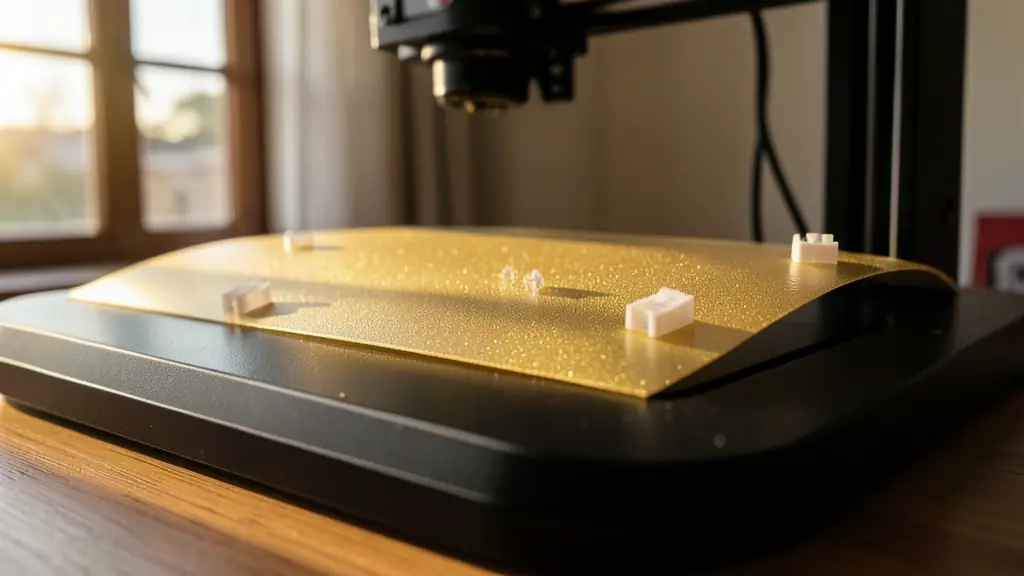
Ask anyone who has watched a twelve hour print turn into a ball of spaghetti at hour three, and the cause is usually the bed, not the printer. The sheet under the nozzle decides whether a first layer grips, whether a tall part stays put, and whether it comes off without a screwdriver. Swapping a worn or wrong surface is one of the cheapest fixes in 3D printing, and getting the match right between plastic and plate saves more failed prints than any slicer trick.
The surfaces you will be offered
- Smooth PEI on spring steel: a mirror finish on the bottom of the part, very strong grip for PLA, sometimes too strong for PETG.
- Textured PEI: a powder coated, speckled finish that hides small marks, lets PETG go once it cools and forgives a slightly high nozzle.
- Glass: flat and cheap, glossy underside, but heavy, slow to heat and needs glue stick for most plastics.
- Bare spring steel with a magnetic base: the carrier for PEI sheets; flex it and parts pop off.
Which plastic grips which plate
PLA sticks to almost anything clean, and textured or smooth PEI both work at a bed of around 50 to 60 °C. PETG bonds so hard to smooth PEI that it can tear flakes out of the coating when you pull the part, so put a thin layer of glue stick down as a release, or use textured PEI. ABS and ASA want a hot bed, often 90 to 110 °C, and an enclosure to stop the corners lifting. TPU grips well and can be hard to remove; a release layer helps here too.
The print settings guide lists bed temperatures per material, and the spool label has the final say. See PETG filament for more.
A first layer routine that works
- Wash the sheet with warm water and dish soap, rinse and dry it with a clean cloth. Skin oil from fingers is the usual enemy.
- Between washes, a wipe with IPA is fine.
- Heat the bed fully and wait a few minutes before levelling, so the plate has finished moving.
- Level or run the auto levelling probe, then print a single layer square and look at it: lines should touch and flatten slightly, with no gaps and no ridges.
- Adjust the Z offset in small steps until it does.
When the sheet has had enough
Parts lift in one spot only: that area is worn or scratched; a dent in spring steel or a dull patch in PEI will not grip again. Prints fall off everywhere even after washing: the coating is worn smooth, or the sheet has bent and no longer sits flat on the magnet. Bubbles under the surface: the PEI has come loose from the steel. In each case a new sheet is the fix. Order the exact size for your bed, check the magnet type matches, and keep one spare next to your other 3D printer parts.
What to put in your request
- The printer model and the bed size in mm
- Whether the base is magnetic or clips on
- The plastics you print most, PLA or PETG
- Smooth, textured or both surfaces wanted
- A photo of the worn sheet or the bed corners
3D Printer Build Plates for makers, schools, engineers and businesses
- Makers and hobbyists: a textured sheet that lets PLA miniature bases and household clips pop off cleanly
- Schools, colleges and makerspaces: spare sheets so a class's prints can come off while the next job starts
- Engineers and product designers: a flat, clean bed for fit check parts where a warped base ruins the measurement
- Small businesses and sellers: several swap sheets on each print farm machine so parts cool off the printer
- Factories, mines and workshops: a high temperature surface for nylon and ASA jigs printed in the workshop
- Dental labs and clinics: smooth flat surfaces for orthotic test shapes and clinic aids the team approves
- Car owners and panel shops: a hot bed and good grip for long ASA trim strips that tend to lift at the ends
- Architects, artists and prop makers: smooth PEI for glossy sign faces and architectural model base plates