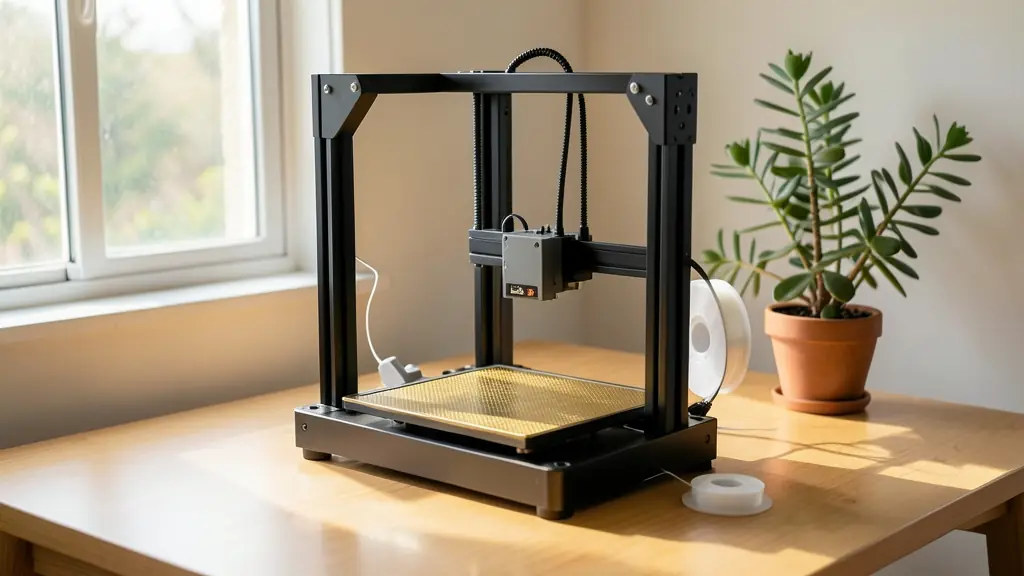
Start with the part, not the printer. A learner in Benoni printing phone stands, a dental lab in Sandton fussing over model accuracy and a cosplayer in Pretoria planning a full helmet need three very different machines. Decide what you will print, how big, how fine and in which plastic or resin. The process then picks itself, the bed size follows, and only after that do the extra features earn their price. Here is that order, and how to read a spec sheet without paying for things you will never switch on.
Five decisions, in this order
- The parts. Write down the biggest thing you expect to print, the finest detail and the material it needs.
- The process. Filament (FDM) for brackets, boxes and big parts; resin (MSLA) for miniatures, jewellery and dental models. See resin 3D printers.
- The bed. Size it to your largest part with some room spare. Very big parts belong on large format 3D printers.
- The time savers. Auto levelling, a direct drive extruder, an enclosure, a camera, or a multicolour unit.
- The back up. Who repairs it here, and which spares sit on a shelf in South Africa.
Filament or resin splits the choice in two
A filament machine melts a spool of plastic through a hot nozzle. It is forgiving, cheap to run and happy in a spare room. Resin machines cure liquid with UV light under an LCD screen, giving far finer surfaces, but every print needs gloves, a wash and a cure, so they want a ventilated space of their own.
Most homes and schools start with filament. If money is tight, read budget 3D printers before you shop. If you only need to copy an existing object, a 3D scanner may matter as much as the printer, and for small craft repairs a 3D pen can be enough.
Reading the spec sheet
- Build volume in mm, width x depth x height: check your part with the will it fit calculator.
- Maximum nozzle temperature: around 260 °C covers PLA, PETG, ABS and ASA; nylon and PC want more.
- Maximum bed temperature: 100 °C or higher if ABS or ASA is on your list.
- Open or closed frame: open is easy to reach into, closed keeps heat in and dust out.
- Extruder type: direct drive handles flexible TPU better than a long bowden tube.
After the sale
Under the Consumer Protection Act you have a warranty on defective goods, but a warranty helps little if the printer must travel overseas for repair. Ask the seller who fixes it locally, how long that takes, and whether nozzles, a hot end and a build sheet are stocked here.
Compare offers on the same machine and the same bundle; 3D printer prices explains why two adverts for one model can differ.
What to put in your request
- The largest part you will print, in mm
- The materials you plan to use
- Filament or resin, if you already know
- Features you want: levelling, enclosure, camera
- Your budget and the delivery town
3D Printers for Sale for makers, schools, engineers and businesses
- Makers and hobbyists: a desk machine for household fixes, cosplay pieces, toys and spare clips around the house
- Schools, colleges and makerspaces: classroom printers for technology projects, robotics parts and learners' first designs
- Engineers and product designers: a bench printer for overnight prototypes, fit checks and test parts before tooling
- Small businesses and sellers: machines for a print farm, shop displays, custom signs and small runs for online orders
- Factories, mines and workshops: a workshop printer for jigs, guards and stopgap spares while imports are on the way
- Dental labs and clinics: a resin machine for dental and orthotic models the lab checks before use
- Car owners and panel shops: a printer for clips, trims and brackets on older cars, tested for fit before final prints
- Architects, artists and prop makers: printers for architectural models, props, sculptures and casting patterns for jewellery