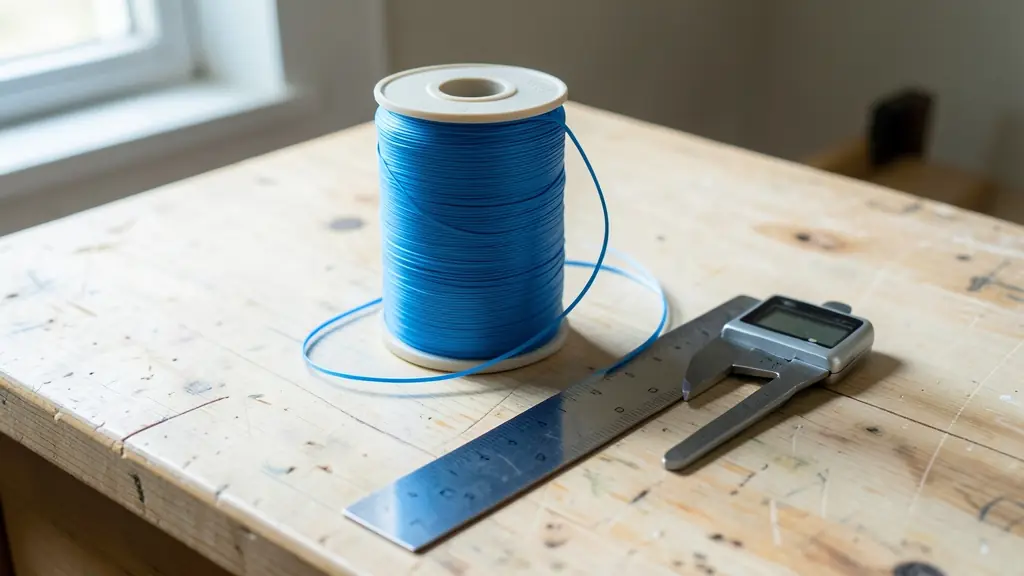
Slicers report filament in metres, spools are sold in kilograms, and a half used spool on the shelf is somewhere in between. This tool converts between the two from the material's density and the filament's cross section. A kilogram of 1.75 mm PLA holds roughly 330 m; the same kilogram of ABS, which is lighter, runs nearly 400 m. Pick a material, pick 1.75 or 2.85 mm and type either figure. For choosing the material itself, see 3D printer filament.
The sum behind it
Filament is a long cylinder. One metre of 1.75 mm filament has a volume of about 2.4 cm³, and the material's density turns that into grams: PLA at about 1.24 g/cm³, PETG 1.27, ABS 1.05, TPU 1.21. The densities come from makers' data sheets, and different makers' figures for the same plastic differ by a few percent, so treat the result as close, not exact.
For 2.85 mm filament the cross section is about 2.65 times larger, so a spool holds far fewer metres for the same weight. Check which size your printer takes before you buy: the extruder, the hot end and the slicer profile are all set for one diameter, and the wrong one will not feed.
Checking what is left on a spool
- Weigh the spool on a kitchen scale.
- Subtract the empty spool. Weigh an empty one of the same kind; cardboard and plastic spools differ a lot.
- Type the grams that are left. The tool shows the metres, which you can compare with the slicer's figure before a long print.
If the slicer wants 95 m and the spool has 90, swap it now, not at 2 a.m.
Parts per spool
Type the grams one part needs and the spool size: the tool divides and rounds down. Leave a few percent for the purge line, the first layer test and the one that fails. A filament changer that purges between colours uses far more, often several grams a change, which is why multicolour printers eat spools faster. For print farm buying, a 5 kg spool means fewer changes but needs a bigger holder. Compare spools on PLA filament.
Sources
- Filament maker B, PLA technical data sheet: density 1.24 g/cm³; nozzle 190 to 230 °C; bed 35 to 45 °C (smooth cool plate); drying 55 °C for 8 h; heat deflection 54 °C at 1.8 MPa, 57 °C at 0.45 MPa; Vicat 57 °C
- Filament maker A, PLA technical data sheet: density 1.17 g/cm³; nozzle 190 to 230 °C; build plate 25 to 60 °C; drying 55 °C for 6 h; heat deflection 58 °C at 1.8 MPa, 60 °C at 0.45 MPa; Vicat 63 °C
- Filament maker C, PETG technical data sheet: nozzle 250 ± 10 °C; bed 80 ± 10 °C; density 1.27 g/cm³; heat deflection 68 °C at 0.45 and 1.8 MPa; material page: enclosure not required
- Filament maker A, ABS technical data sheet: density 1.12 g/cm³ on the sheet (1.04 in the maker's summary table, FM11); nozzle 245 to 265 °C; build plate 90 to 100 °C; fan off; drying 70 °C for 6 h; heat deflection 98 °C at 1.8 MPa, 100 °C at 0.45 MPa
- Filament maker A, TPU 95A technical data sheet: density 1.20 to 1.24 g/cm³; nozzle 210 to 230 °C; build plate 25 to 60 °C; drying 70 °C for 8 h; no heat deflection figure
- Filament maker A, technical data at a glance (summary table): density and heat deflection at 0.45 MPa: PLA 1.17 and 60 °C, PLA Pro 1.23 and 59 °C, PETG 1.25 and 78 °C, ABS 1.04 and 100 °C, ASA 1.13 and 103 °C, TPU95 1.22, PC 1.19 and 111 to 114 °C, silk PLA 1.24 (Vicat 64.7 °C); nylon 6 carbon fibre 1.17 and 215 °C annealed, nylon 12 carbon fibre 1.06 and 131 °C annealed
- Filament maker C, PLA product page: 1.75 mm, ±0.02 mm manufacturing precision, 1 kg spool
- Filament maker C, home page: ±0.02 mm for the vast majority of materials against an industry norm of 0.05 mm; TPU 95A in a 500 g spool, PETG in 2 kg
- Printer maker, 2.85 mm PLA material page: filament diameter 2.85 mm, spool weight 750 g
- Filament reseller, 5 kg PLA spool product page: 5 kg spool of 1.75 mm PLA, ±0.03 mm, spool about 304 mm across
Frequently asked questions
How many metres are on a 1 kg spool of 1.75 mm PLA?
Does the spool weight on the label include the spool?
Why is 2.85 mm filament so much shorter per kilogram?
Can I ask suppliers for a quote on bulk filament?
More calculators and tools
- 3D print cost calculatorFilament, electricity, machine wear and failures: the cost of one print
- Print time estimatorPart size, solidity and printer: material volume, grams and hours
- Resin calculatorMillilitres, grams, bottles and cost for resin prints
- Print settings guideNozzle, bed, drying and enclosure for each filament
- Will it fit calculatorPart size against printer build volumes, flat, on its side or diagonal
- Backup power calculatorBattery and inverter size to finish a print through load shedding
- Nozzle flow calculatorVolumetric flow from nozzle, layer, width and speed, against hot ends