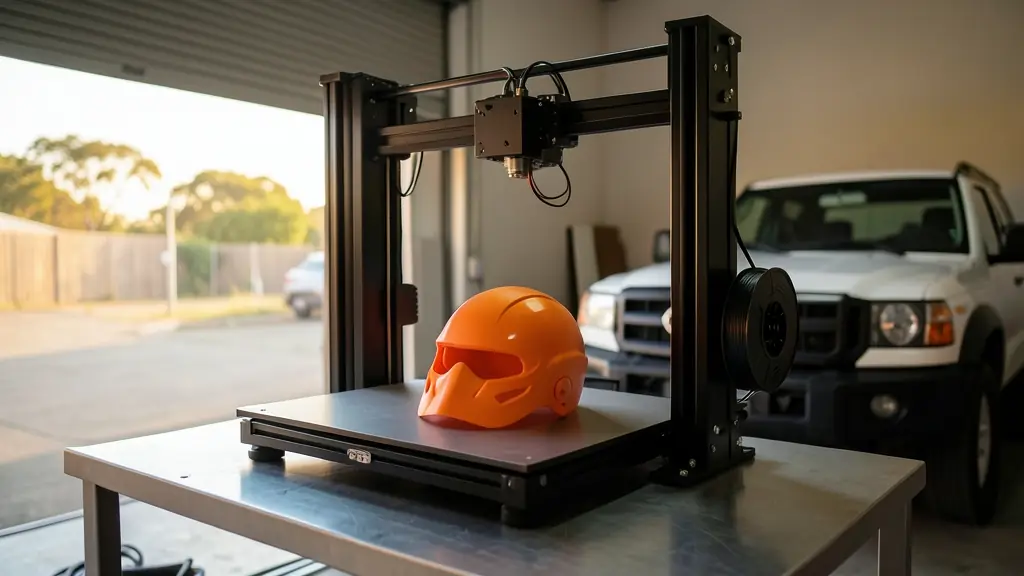
A cosplayer in Pretoria printing a helmet in eight pieces spends as long sanding seams as printing. A sign shop needs letters half a metre tall, and a furniture maker wants a chair foot jig in one go. That is when a bed of 300 mm or more starts to pay. Big machines are not just small ones scaled up, though: they take longer to heat, need a flatter bed, warp long parts more easily and want floor space and power planned around them. Here is what changes.
What gets harder as the bed grows
- Heat up time: a large heated bed can take many minutes to reach PETG temperatures and draws far more power while it does.
- Flatness: a bed a few tenths of a millimetre out over 500 mm ruins first layers; mesh levelling helps, but cannot fix a warped plate.
- Warping: long parts shrink more, so corners lift. PETG and PLA behave; ABS needs an enclosure.
- The nozzle: a 0.6 or 0.8 mm nozzle lays thicker lines and finishes big parts in hours instead of days. Check the hot end with the nozzle flow calculator.
Floor space and power
Measure the door before you buy. Some large machines arrive in crates that will not fit a narrow passage, and they need a solid table that does not wobble when the gantry moves. Leave room around it to reach the bed and change spools.
A long print running two days is likely to meet a power cut. Check the printer's label for wattage, use the backup power calculator to size a battery and inverter, and fit a surge protector.
Or split the part and join it
Before buying a big printer, try the will it fit calculator: it says how many pieces a part needs on a normal bed. Splitting with locating pins and a good glue, or welding seams with a 3D pen, often gives a stronger result than one tall print that warps.
If you need one big part a year, a print bureau may be cheaper; see 3D printing services.
Jobs that justify the size
Full cosplay helmets and armour plates, shop signage and channel letters, furniture feet and brackets, drilling and assembly jigs for a factory line, and site models for an architect in Stellenbosch. In each, the gain is fewer seams and less finishing. For general advice on choosing, start at 3D printers for sale.
What to put in your request
- The largest part in mm: length, width, height
- The material you will print most
- Where the printer will stand and the door width
- Whether you want set up and training on site
- Your budget and delivery town
Large Format 3D Printers for makers, schools, engineers and businesses
- Makers and hobbyists: full cosplay helmets, armour and large display pieces printed with fewer seams
- Schools, colleges and makerspaces: a shared makerspace machine for robotics chassis, stage props and group projects
- Engineers and product designers: full size housings and assembly fixtures checked in one piece rather than in halves
- Small businesses and sellers: signage letters, shop fittings and display stands printed in house
- Factories, mines and workshops: drilling jigs, guards and conveyor parts that are long or awkward to import
- Dental labs and clinics: large anatomical models for training rooms, not for use on patients
- Car owners and panel shops: bumper inserts, ducting and panel test pieces checked against the car
- Architects, artists and prop makers: site models, film props and sculpture printed in large sections