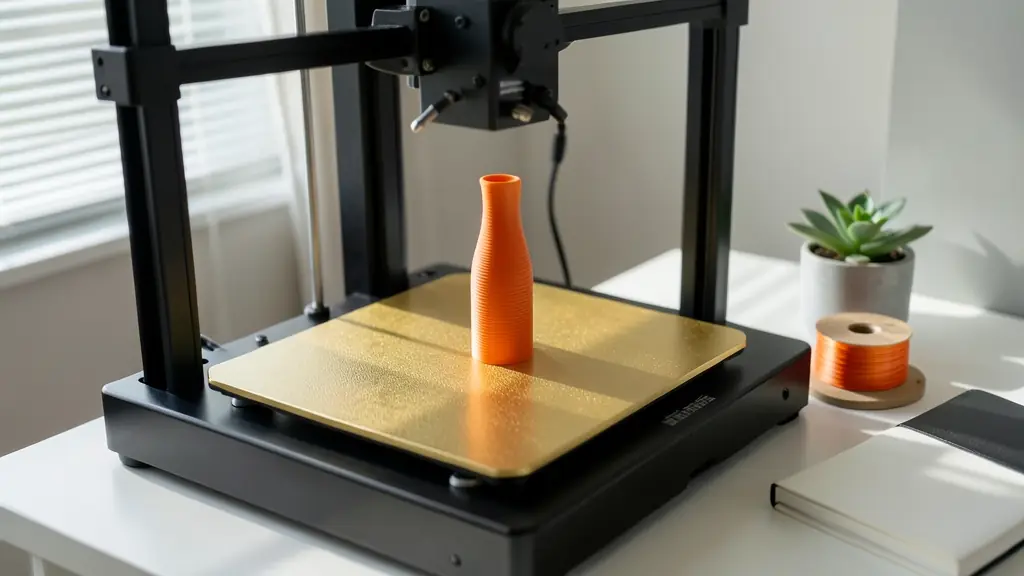
Load a fresh spool on an open frame printer, set the nozzle near 200 °C and the bed around 60 °C, and PLA will usually just print. It barely shrinks as it cools, so corners stay flat without an enclosure, and the smell is mild enough for a bedroom desk in Benoni. That is why most printers ship with it and most beginners stay on it for months. The trouble starts only when a PLA part meets heat, a hard knock or years of sun.
Why it prints so easily
PLA flows well at modest temperatures, typically 190 to 220 °C, and sticks to most beds at 50 to 60 °C. It needs no heated chamber, forgives a bowden extruder and a basic hot end, and gives sharp detail with crisp overhangs. That makes it the right material on a budget printer and in a classroom.
It is also stiff. A PLA jig or a display stand holds its shape well, as long as it stays cool and nobody drops it on a tiled floor.
Where PLA lets you down
- Heat: it softens at around 55 to 60 °C. A phone holder on a dashboard in a Karoo summer will sag in an afternoon; so can a part on a sunny windowsill.
- Impact: it snaps rather than bends, so clips and hinges crack.
- Outdoors: UV and weather make it brittle and faded over time.
- Food: not for food or drink unless the material and process are certified, and even then wash and seal it.
For heat or sun, step to PETG or ASA.
PLA+, matte and high speed grades
PLA+ or tough PLA blends in additives that make it less brittle; it often wants a slightly hotter nozzle. Matte PLA hides layer lines nicely on models and is a little weaker between layers. High speed PLA flows faster for core XY machines; check the flow your hot end can melt with the nozzle flow calculator.
None of these are standard names, so read each spool's label for its temperatures.
Telling a good spool from a poor one
- The strand is round and the same width at a few points with calipers.
- It is wound in neat rows, with no crossed loops that tangle.
- It bends before it snaps; brittle PLA is often damp or old.
- The label gives a tolerance, temperatures and a batch.
- The colour stays even through the spool.
What to put in your request
- Standard, PLA+, matte or high speed grade
- Colours and whether they must match a batch
- Spool size: 1 kg, 2 to 3 kg or 5 kg
- Kilograms a month for a regular order
- Your town and when you need it delivered
PLA Filament for makers, schools, engineers and businesses
- Makers and hobbyists: miniature terrain, desk organisers and household fixes that stay indoors and cool
- Schools, colleges and makerspaces: learners' first designs printed on open classroom machines without fumes or warping
- Engineers and product designers: fast fit checks and form models before the final part goes to a tougher material
- Small businesses and sellers: name signs, keyrings and shop displays printed in matched colours on a print farm
- Factories, mines and workshops: quick go no go gauges and drill guides used indoors, away from heat
- Dental labs and clinics: anatomy teaching models and holders, never parts that go in or on the body
- Car owners and panel shops: test fit prints of a clip or trim before printing the real one in ASA
- Architects, artists and prop makers: architects' site models and painted props where detail matters more than heat