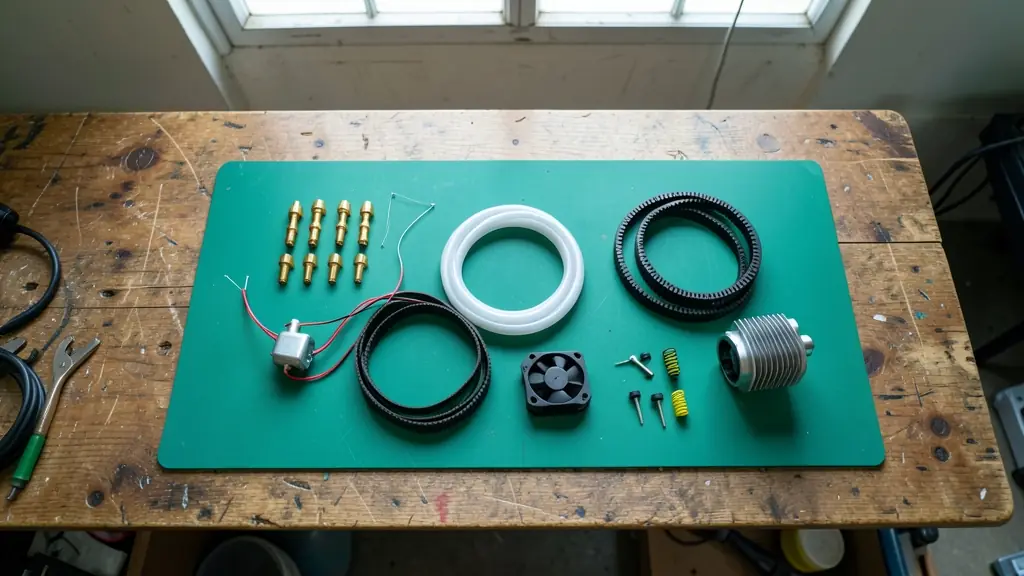
Printers rarely die. They stop because a small part wore out at nine at night, and the nearest shop that stocks it is a courier away. Keeping a few spares in a drawer turns a lost week into a ten minute swap. The trick is knowing which parts wear, how they show it, and buying the version that fits your machine, because a heater cartridge for the wrong voltage or a nozzle with the wrong thread will not help anyone.
The short list for the drawer
- Nozzles, a few in your usual size, plus one hardened if you print abrasives. See 3D printer nozzles.
- A PTFE tube length, and the push fit couplers that hold it.
- A heater cartridge and a thermistor, the pair behind most temperature errors.
- A cooling fan for the hot end and one for the part.
- A belt for each axis, or one long length to cut.
- Springs or silicone spacers for the bed, if your machine levels with knobs.
- A spare build sheet; build plates covers the choices.
Symptom and the part behind it
- Thin, gappy walls after months of fine prints: a worn or part blocked nozzle.
- Filament grinding, clicking at the extruder: a clog, often from a burnt PTFE tube end.
- A heating error or temperature that jumps: a loose or failing thermistor.
- The hot end slow to warm up: a tired heater cartridge or a bad crimp.
- Layers stepping sideways: a loose or stretched belt, or a cracked pulley.
- Overhangs curling, a loud rattle: a part cooling fan on its way out.
Buying for your exact machine
Before you order, find the model and, where it applies, the hardware revision. Then check three things: the voltage (many printers run 24 V, older ones 12 V, and the heater must match), the connector on the end of the wires, and the thread on anything that screws in. Belt width and tooth profile matter too.
A photo of the old part beside a ruler saves a wrong delivery. If the fault is beyond a swap, a technician can help; see 3D printer repair.
Upgrades that pay back
Some replacements are worth upgrading while you are in there. An all metal hot end lets you print hotter materials, a better part fan helps PETG bridges, and a dual gear extruder grips flexible filament more firmly. Silicone spacers in place of springs keep a bed level for longer.
Keep upgrades to one at a time, print a test after each, and keep the old part in the drawer in case you need to go back.
What to put in your request
- The printer model and hardware revision
- The voltage: 12 V or 24 V
- A photo of each old part beside a ruler
- How many of each spare you want
- Whether you want a technician to fit them
3D Printer Parts for makers, schools, engineers and businesses
- Makers and hobbyists: a small drawer of nozzles, a PTFE tube and a thermistor so weekends are not lost
- Schools, colleges and makerspaces: spares for each classroom machine so one fault does not stop a whole project
- Engineers and product designers: a spare hot end ready so a deadline print does not wait on a courier
- Small businesses and sellers: a stocked shelf of belts, fans and heaters for a print farm running every night
- Factories, mines and workshops: spares held on site for printers making jigs in a plant far from a city
- Dental labs and clinics: a kept spare set so a lab printer making models is not down for long
- Car owners and panel shops: spares for the workshop printer that makes clips and trims between jobs
- Architects, artists and prop makers: a spare build sheet and nozzles for printers making models to a client deadline