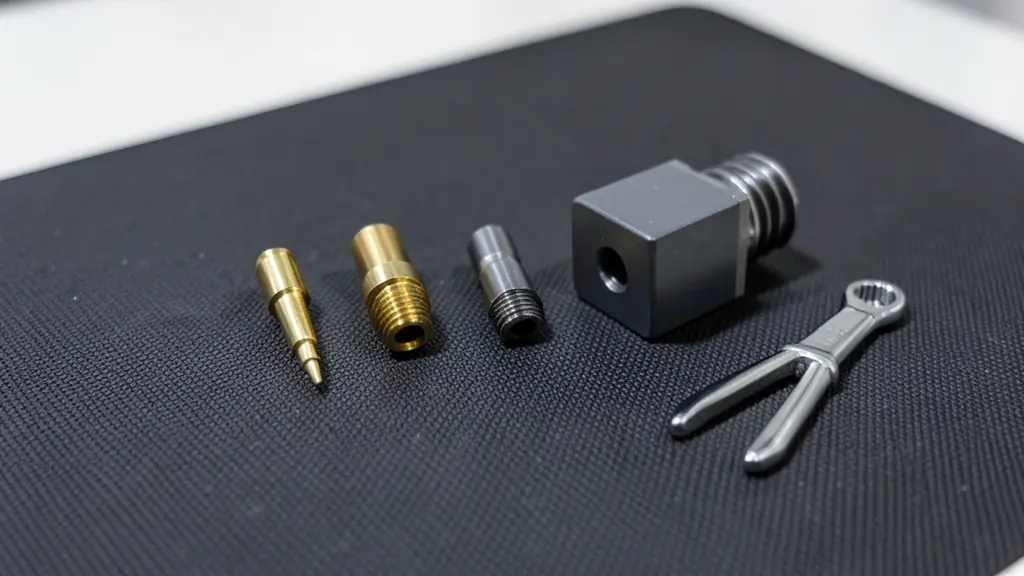
A printer advertised at 500 mm/s can only print as fast as its hot end melts plastic. That limit is the volumetric flow, in cubic millimetres a second: layer height times line width times speed. A 0.4 mm nozzle laying 0.2 mm layers at 0.45 mm wide and 100 mm/s needs 9 mm³/s, about what a common V6 class hot end handles. This calculator does the sum and shows where each class of hot end runs out of melt. Nozzle sizes are on 3D printer nozzles.
The four hot end classes
- Standard, V6 class: about 12 mm³/s of PLA, from makers' figures and independent tests.
- High flow, long melt zone: about 25 mm³/s with a 0.6 mm nozzle.
- Split melt path or ceramic heater: about 35 mm³/s, from a 0.6 mm nozzle up.
- Stock hot end of a fast core XY printer: about 21 mm³/s, the limit its maker sets in the slicer for PLA.
These are for PLA. PETG, ABS and nylon usually flow less at the same temperature, so leave a margin. The figures come from hot end makers' flow tables, independent tests and the printer makers' own slicer limits; your hot end may manage a little more or less, so treat the top speed as a guide and test before a long job.
Symptom: cause
- Gaps in walls at high speed, fine when slow: over the hot end's flow; slow down or raise the temperature a little.
- Clicking extruder: the plastic cannot melt fast enough, or the nozzle is partly blocked.
- Weak layers on a fast print: the plastic left the nozzle too cool to bond.
- Fine on PLA, gaps on PETG: a lower flow limit for that material.
Layer height and line width
Layers between 25% and 75% of the nozzle diameter print well; slicer makers give 20% to 80%. Line width defaults to about 1.1 times the nozzle. A bigger nozzle with thicker layers moves far more plastic at the same speed, which is why big parts print faster on 0.6 or 0.8 mm. For time per part, see the print time estimator; for hot end upgrades, 3D printer parts.
Sources
- Hot end maker, brass nozzle flow rates: standard flow, PLA at 220 °C: 0.4 mm 13, 0.6 mm 14, 0.8 mm 17 mm³/s
- Hot end maker, high flow nozzle flow rates: high flow, PLA at 220 °C: 0.4 mm 16, 0.6 mm 22, 0.8 mm 28, 1.0 mm 35 mm³/s; tested at layer height 50% and line width 125% of the nozzle
- Independent test lab blog, hot end flow rate benchmark: a V6 class hot end on PLA at 215 °C: about 10 to 15 mm³/s is the limit; skipping starts at 15
- Independent test lab blog, split melt path nozzle review: at the 5% under extrusion limit: V6 class 0.6 mm about 15, volcano class 0.6 mm about 30 and 1.0 mm about 45, split melt path 0.6 mm about 40 and 1.0 mm about 60 mm³/s
- Printer maker C, maximum volumetric speed guide: standard all metal V6 class 8 to 12; high flow hot ends 25 to 40; high flow nozzles 20 to 35; the maker's own extruder 15 to 20 mm³/s
- Hot end maker, maximum flow rates of its high flow hot ends: standard model about 35 mm³/s, large melt zone model about 40 mm³/s (material and nozzle not stated)
- Printer maker B, slicer filament profile (PLA): maximum volumetric speed for its PLA on its enclosed core XY printer: 21 mm³/s with the standard hot end, 29 with the high flow one; generic PLA 12
- Printer maker B, volumetric speed explained: its PLA on a current core XY model is specified at 25 mm³/s; high flow 0.4 mm nozzle about 35, high flow 0.6 mm up to 40
- Printer maker J, fast core XY printer spec sheet: 220 x 220 x 250 mm; rated 350 W; hot end claimed to 32 mm³/s maximum flow
- Printer maker B, layer height guide: a reasonable layer height is 20% to 70% of the nozzle diameter; 0.08 to 0.28 mm for a 0.4 mm nozzle
- Open source slicer wiki, layer height: the usual range is 20% to 80% of the nozzle diameter; below 20% shows fish scale patterns, above 80% risks poor layer adhesion
- Printer maker C, creating profiles for different nozzles: layer height at most 70 to 80% of the nozzle; extrusion width about 110% of the nozzle, and 1.125 x the nozzle when the width is left at 0
- Printer maker C blog, nozzles with a different diameter: 0.25 mm for fine detail, text and jewellery, much slower; 0.4 mm the default; 0.6 mm for parts without tiny detail, can roughly halve print time; 1.0 mm up to five times faster than 0.4 mm, usually at 0.5 mm layers, rough look
Frequently asked questions
What is volumetric flow in 3D printing?
How fast can a standard hot end print PLA?
Does a hardened steel nozzle reduce flow?
Can a technician fit a high flow hot end for me?
More calculators and tools
- 3D print cost calculatorFilament, electricity, machine wear and failures: the cost of one print
- Filament length calculatorGrams to metres and back, and how many parts one spool prints
- Print time estimatorPart size, solidity and printer: material volume, grams and hours
- Resin calculatorMillilitres, grams, bottles and cost for resin prints
- Print settings guideNozzle, bed, drying and enclosure for each filament
- Will it fit calculatorPart size against printer build volumes, flat, on its side or diagonal
- Backup power calculatorBattery and inverter size to finish a print through load shedding