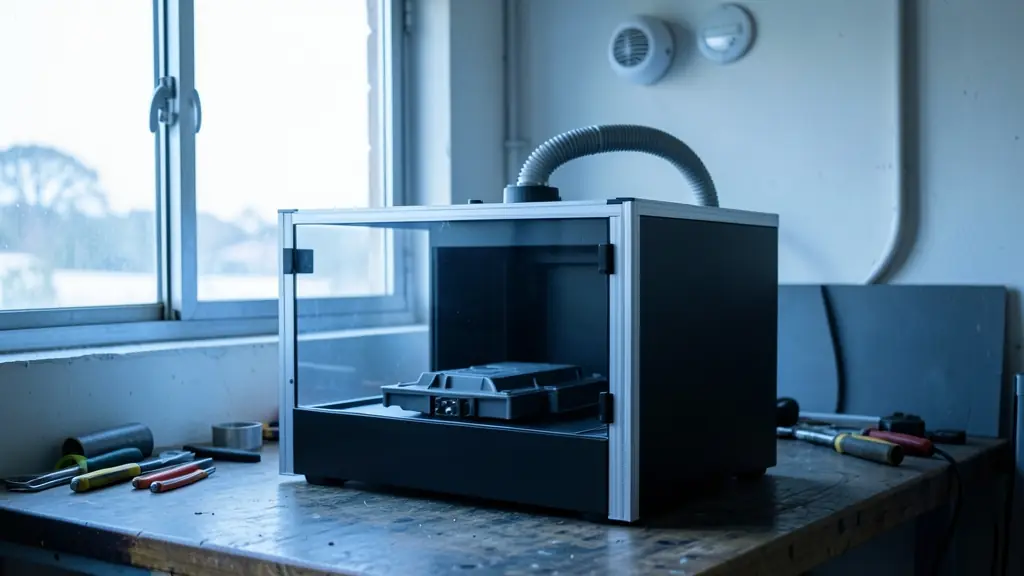
Cold air is the enemy of ABS. On a Highveld winter morning, a part printing in an open garage cools unevenly, the corners curl and the layers split down the side. Put a box around the printer and the air inside stays warm and still, which is often all the difference between a cracked housing and a clean one. A good enclosure also cuts noise, keeps dust and cat hair off the bed and gives the fumes one place to leave from.
What closing the doors actually changes
- Warmth: ABS, ASA and nylon shrink as they cool; warm, still air slows that, so less warping and fewer layer cracks. See ABS and ASA filament.
- Drafts gone: a fan, a passage door or a ceiling fan no longer blows across the part.
- Noise down a little, which matters in a flat or a classroom.
- Dust and fluff stay off the bed and out of the rods.
- Small hands and paws stay away from a hot nozzle and moving belts.
Buy one, or build one from a cabinet
Ready made enclosures come as folding fabric tents, acrylic and aluminium boxes and printers sold with a closed frame. A tent is cheap and light but holds less heat and gives no fume control. A rigid box takes a fan and filter and lasts.
Many makers build their own from a low cupboard or two stacked bedside tables with a perspex door. Leave room around the frame for the bed to travel, put the power supply and the board outside the hot space if you can, and use a frame that will not sag over time. Ask the supplier about panel thickness and whether a vent hole is cut.
Fumes, PLA and fire: the rules of the box
If you print ABS or ASA, lead the air outside with a small fan and a duct to a window, or run a carbon and particle filter inside. Styrene and fine particles build up in a closed room. If you print PLA, open the door or lift the lid: the plastic softens around 55 to 60 °C, and a warm box can make it jam in the hot end or sag on the bed. The print settings guide shows which materials want an enclosure.
Always: fit a smoke detector near the printer, keep it on a non flammable surface, and check on a long print every few hours rather than leaving it running alone for days.
Questions to put to the seller
- Will my printer fit with the bed at its furthest travel, in mm?
- Is there a cut out or mount for an exhaust fan and duct?
- Does the panel material handle the heat of a bed running near 100 °C?
- Can the power supply sit outside the box?
- Is there a cable entry and a way to see the print without opening the door?
What to put in your request
- The printer model and its outside size in mm
- The plastics you plan to print in it
- Whether you want an exhaust fan and duct
- Rigid box, fabric tent or cabinet kit
- Where it will stand: garage, office or classroom
3D Printer Enclosures for makers, schools, engineers and businesses
- Makers and hobbyists: a garage box that lets ABS cosplay parts and drone frames print without cracking
- Schools, colleges and makerspaces: closed printers that keep learners' fingers away from hot nozzles and moving belts
- Engineers and product designers: steady warm air for ASA and nylon test parts that must hold their dimensions
- Small businesses and sellers: enclosed rows on a print farm shelf to cut noise and dust in a shared unit
- Factories, mines and workshops: a heated box for nylon jigs and covers printed beside a dusty workshop floor
- Dental labs and clinics: a clean, closed space for printing clinic aids and models away from dust
- Car owners and panel shops: warm printing for ABS and ASA vent parts and trims that warp in open air
- Architects, artists and prop makers: quiet overnight printing of large props in a studio or a shared flat