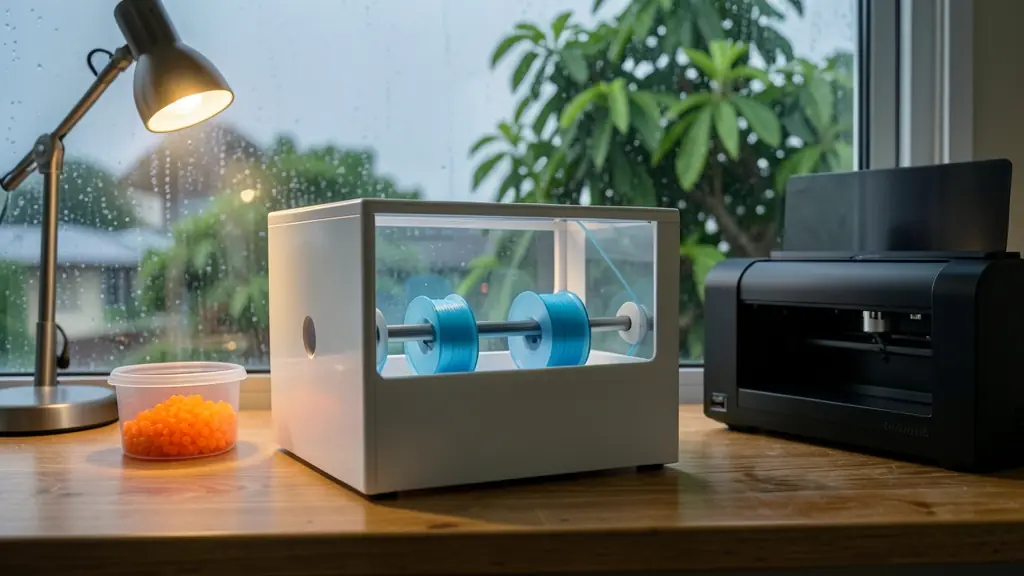
Plastic pulls water out of the air the way bread goes stale on the counter, slowly and without telling you. A spool left open in a Durban flat in February, or in a Cape Town garage through the winter rains, can print badly within days. The dad in Durbanville whose printer suddenly strings is usually not looking at a broken machine. He is looking at a damp spool, and the fix is heat, time and a sealed box to keep it dry afterwards.
How a wet spool gives itself away
- Popping or crackling at the nozzle: water boiling as it hits the hot end.
- Fine strings and wisps between parts, even with retraction that worked last month.
- A rough, fuzzy skin where a smooth wall used to be, sometimes with small bubbles.
- Weak layers that split along the lines when you bend the part.
- Brittle filament that snaps in the tube, common with old PLA.
Nylon, TPU and PETG suffer worst; PLA is slower to take on water but not immune. If the spool has sat open for weeks near the sea, assume it is wet before you blame the slicer.
Dryer box, dehydrator or the oven
A filament dryer box is a small heated case that holds one or two spools at a set temperature, and many let you print straight out of them. A food dehydrator with the trays cut out does the same job if its thermostat is honest, and it often holds more spools.
The kitchen oven is the risky option. Many ovens overshoot at low settings and have hot spots near the element, and a plastic spool can sag or weld its filament together before you notice. If you try it, check the temperature with a separate thermometer and never leave it.
Temperatures and hours, in general terms
The label on the spool rules, but typical starting points look like this: PLA around 45 to 55 °C, PETG and TPU somewhat warmer, nylon around 60 to 80 °C. Most spools need a few hours, nylon often longer. Go hotter than the label suggests and the filament softens and sticks to itself on the spool.
The print settings guide lists drying ranges per material alongside nozzle and bed temperatures, and nylon and carbon fibre filament explains why those grades cannot skip this step.
A routine for a humid town
- Open a new spool only when you are ready to print it.
- Dry anything that has been out for more than a week or two, sooner for nylon and TPU.
- Print hygroscopic materials from a sealed dry box with desiccant, the filament fed through a tube.
- Store spools in airtight tubs with silica gel, and dry the gel when its colour changes.
- Write the drying date on masking tape on the tub so you know what you last did.
What to put in your request
- How many spools you want to dry at once
- The materials you print, nylon and TPU included
- The spool sizes: 1 kg, 2 kg or larger
- Whether you want to print from the box
- Your town and how soon it must arrive
Filament Dryers for makers, schools, engineers and businesses
- Makers and hobbyists: one dryer box on the desk so the PETG and TPU spools stop popping
- Schools, colleges and makerspaces: sealed tubs and a dryer so classroom spools survive the holidays in a damp lab
- Engineers and product designers: nylon and PC dried before each run so test parts reach their real strength
- Small businesses and sellers: several spools dried together so a print farm does not lose a night to stringing
- Factories, mines and workshops: engineering filament kept dry beside the printer in a humid plant or mine workshop
- Dental labs and clinics: spools for orthotic and clinic aids kept dry so prints come out consistent
- Car owners and panel shops: ASA and nylon dried before printing clips and ducts that must not split
- Architects, artists and prop makers: silk and transparent spools dried so the surface stays glossy for display