Two bureaus can quote very different amounts for the same file, and both can be fair. The number comes from a short list: how many grams of plastic go in, how many hours the machine is tied up, the time a person spends setting up and finishing, any minimum order, and getting it to you. Once you know how each piece moves, you can read a quote properly and change your part so it costs less without getting worse.
The lines inside a print price
- Material: the weight of the part plus supports, in grams, priced per material. Nylon, CF grades and resin cost more than PLA.
- Machine time: hours on the printer, which often outweighs the plastic on a slow, detailed print.
- Set up: checking the file, slicing, the first plate and any test print.
- Post processing: removing supports, sanding, priming, painting, washing and curing resin.
- Minimum order: many bureaus have a floor price for a small job.
- Colour changes and courier, plus VAT if the bureau is registered.
Why hollow can be cheaper than solid
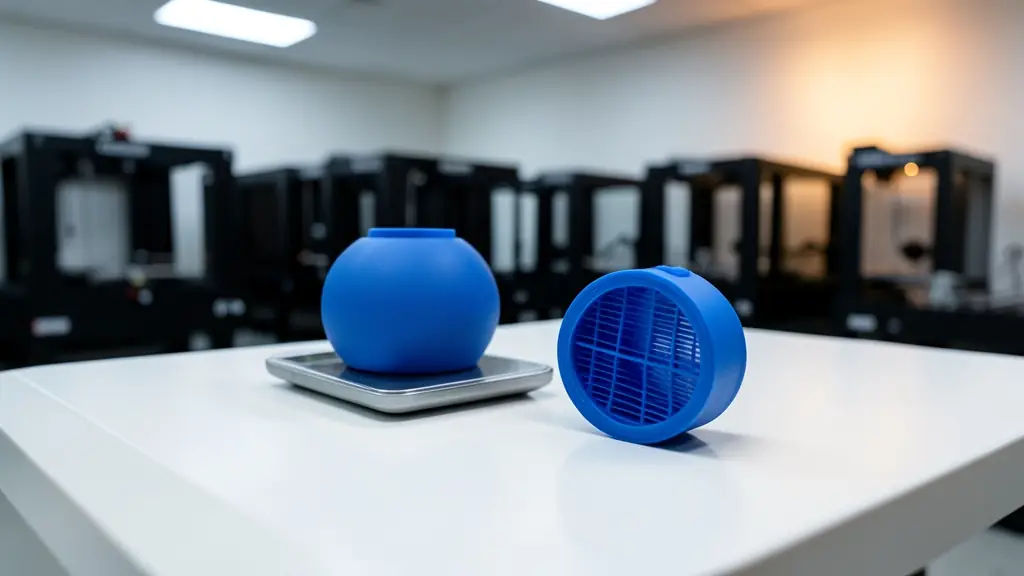
A slicer fills the inside of a part with a light grid, so a block printed at 15% infill uses a fraction of the plastic and hours of a solid one. For a display model or a cover, that is all it needs. A part under load needs more walls and infill, and an engineer decides how much.
Resin works the other way round: a solid resin figure drinks resin, so a bureau hollows it and adds drain holes. Try your own numbers in the print cost calculator and the print time estimator.
Changes that bring the quote down
- Lay the part flat on its biggest face: fewer supports and less time.
- Ask for lower infill where the part only has to look right.
- Split a tall or awkward part into pieces that print flat and glue together; the will it fit calculator shows how many.
- Accept a 0.6 mm nozzle and thicker layers on big, plain parts.
- Order the batch at once rather than one part at a time.
- Skip painting if you can do it yourself.
Comparing two quotes fairly
Check they quote the same material, colour, quantity, layer height and finish, and whether VAT and courier are in. A cheaper quote in PLA is not the same part as a dearer one in PETG for a bracket that sits in a hot bakkie. Ask how they would orient it and whether a test print is included. More on choosing the process is on 3D printing services.
What to put in your request
- The file, so the bureau can weigh it in the slicer
- How many parts, and whether more may follow
- Which faces show and which can carry marks
- Infill and strength: display or working part
- The finish, the deadline and the delivery town
3D Printing Prices for makers, schools, engineers and businesses
- Makers and hobbyists: a cosplay helmet split into pieces so it prints flat and costs less in hours
- Schools, colleges and makerspaces: a class batch of learner projects quoted together to beat the minimum order
- Engineers and product designers: prototype housings priced at low infill for fit, then solid for the final test
- Small businesses and sellers: a per part price for 200 branded keyrings and how it drops at volume
- Factories, mines and workshops: a quote for nylon spares weighed against the cost of a week of downtime
- Dental labs and clinics: dental model batches priced per cm³ of resin with hollowing the lab accepts
- Car owners and panel shops: ASA clips priced in a batch of fifty instead of one at a time
- Architects, artists and prop makers: a site model priced with and without the painted finish