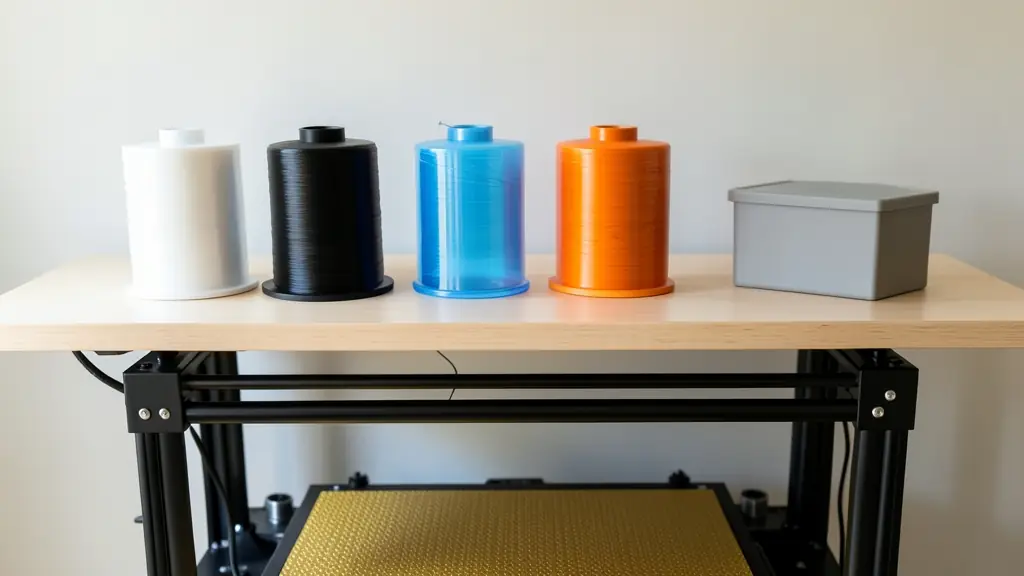
The temperatures here are the ranges where several makers' data sheets overlap, not the extremes one maker allows. Use them as a starting point and let the spool's own label overrule them, because two PETGs can differ by 10 °C. Each material also shows how hot and how long to dry it, whether it needs an enclosure, whether it chews through a brass nozzle, and where it starts to soften. Matching the material to the job is on 3D printer filament.
Reading the ranges
Start in the middle of the nozzle range and print a small temperature tower. Too cold shows as weak layers that snap apart; too hot shows as stringing and blobs. The bed range depends on the surface: textured PEI and smooth glass want different figures, and a cold Highveld morning or a draughty garage may need the top of the range.
The heat figure is the heat deflection temperature from the data sheets, where a test bar starts to bend under a light load. PLA's is around 57 °C, so a PLA phone holder on a dashboard in January will sag.
If this, then that
- Pops, steam and stringing: the filament is wet. Dry it at the listed temperature for the listed hours, then keep it in a sealed box with desiccant. At the coast, PETG, TPU and nylon need this often.
- Corners lifting on ABS or ASA: a draught. Close the enclosure, or build one; see 3D printer enclosures.
- Nozzle wears oval on carbon fibre or glow PLA: the filler is abrasive. Fit a hardened steel nozzle.
- TPU tangles in the extruder: print slower, and a direct drive extruder helps.
Drying without wrecking the spool
A dryer box holds a steady temperature; a kitchen oven has hot spots that can melt the spool or fuse the filament. Many spools are rated only to about 70 °C, so nylon and PC need a spool that takes the heat. Drying times on data sheets range from 6 to 12 hours. Dry a spool that has stood open for weeks, then store it sealed; drying every spool before every print is not needed. For dryer boxes, see filament dryers.
Sources
- Filament maker A, PLA technical data sheet: density 1.17 g/cm³; nozzle 190 to 230 °C; build plate 25 to 60 °C; drying 55 °C for 6 h; heat deflection 58 °C at 1.8 MPa, 60 °C at 0.45 MPa; Vicat 63 °C
- Filament maker A, tough PLA (PLA Pro) technical data sheet: density 1.22 g/cm³; nozzle 190 to 220 °C; build plate 30 to 60 °C; heat deflection 57.6 °C at 1.8 MPa, 59.3 °C at 0.45 MPa; no drying setting given
- Filament maker A, PETG technical data sheet: density 1.25 g/cm³; nozzle 230 to 260 °C; build plate 70 to 80 °C; drying 65 °C for 6 h; heat deflection 75 °C at 1.8 MPa, 78 °C at 0.45 MPa; Vicat 84 °C
- Filament maker A, ABS technical data sheet: density 1.12 g/cm³ on the sheet (1.04 in the maker's summary table, FM11); nozzle 245 to 265 °C; build plate 90 to 100 °C; fan off; drying 70 °C for 6 h; heat deflection 98 °C at 1.8 MPa, 100 °C at 0.45 MPa
- Filament maker A, ASA technical data sheet: density 1.13 g/cm³; nozzle 230 to 260 °C; build plate 75 to 95 °C; drying 70 °C for 7 h; heat deflection 100 °C at 1.8 MPa, 103 °C at 0.45 MPa
- Filament maker A, TPU 95A technical data sheet: density 1.20 to 1.24 g/cm³; nozzle 210 to 230 °C; build plate 25 to 60 °C; drying 70 °C for 8 h; no heat deflection figure
- Filament maker A, nylon (co-polyamide) technical data sheet: density 1.12 g/cm³; nozzle 250 to 270 °C; build plate 25 to 50 °C; drying 100 °C for 8 h; heat deflection 70 °C at 1.8 MPa, 111 °C at 0.45 MPa; brass nozzle abrasion 'happens quite often', hardened steel or ruby nozzle highly recommended; store below 20% RH
- Filament maker A, polycarbonate technical data sheet: density 1.19 g/cm³; nozzle 250 to 270 °C; build plate 90 to 105 °C; drying 75 °C for 6 h; heat deflection 107 °C at 1.8 MPa, 111 °C at 0.45 MPa; enclosure recommended, heated chamber for large parts
- Filament maker A, silk PLA product data: nozzle 190 to 230 °C; build plate 25 to 60 °C; enclosure not needed; drying 55 °C for 6 h only if it has taken up moisture
- Filament maker A, glow in the dark PLA product data: nozzle 190 to 230 °C; build plate 25 to 60 °C; drying 55 °C for 6 h; the glow additive is 'very abrasive', a hardened nozzle is required; otherwise standard PLA settings
- Filament maker A, technical data at a glance (summary table): density and heat deflection at 0.45 MPa: PLA 1.17 and 60 °C, PLA Pro 1.23 and 59 °C, PETG 1.25 and 78 °C, ABS 1.04 and 100 °C, ASA 1.13 and 103 °C, TPU95 1.22, PC 1.19 and 111 to 114 °C, silk PLA 1.24 (Vicat 64.7 °C); nylon 6 carbon fibre 1.17 and 215 °C annealed, nylon 12 carbon fibre 1.06 and 131 °C annealed
- Filament maker B, PLA technical data sheet: density 1.24 g/cm³; nozzle 190 to 230 °C; bed 35 to 45 °C (smooth cool plate); drying 55 °C for 8 h; heat deflection 54 °C at 1.8 MPa, 57 °C at 0.45 MPa; Vicat 57 °C
- Filament maker B, tough PLA technical data sheet: density 1.26 g/cm³; nozzle 190 to 230 °C; bed 35 to 45 °C; drying 55 °C for 8 h; heat deflection 53 °C at 1.8 MPa, 55 °C at 0.45 MPa
- Filament maker B, PETG technical data sheet: density 1.25 g/cm³; nozzle 240 to 270 °C; bed 65 to 75 °C; drying 65 °C for 8 h; heat deflection 65 °C at 1.8 MPa, 69 °C at 0.45 MPa; Vicat 78 °C
- Filament maker B, high temperature nylon carbon fibre technical data sheet: density 1.06 g/cm³; nozzle 260 to 290 °C; bed 80 to 100 °C; drying 80 °C for 8 to 12 h; heat deflection 170 °C at 1.8 MPa, 194 °C at 0.45 MPa
- Filament maker B, silk PLA technical data sheet: density 1.32 g/cm³; nozzle 210 to 240 °C; bed 35 to 45 °C; drying 55 °C for 8 h; heat deflection 50 °C at 1.8 MPa, 53 °C at 0.45 MPa
- Filament maker B, TPU 95A technical data sheet: density 1.20 g/cm³; nozzle 220 to 240 °C; bed 30 to 35 °C; drying in a forced air oven 70 °C for 8 h; heat deflection not applicable
- Filament maker B, wood filled PLA technical data sheet: density 1.21 g/cm³; nozzle 190 to 240 °C; bed 35 to 45 °C; drying in a forced air oven 55 °C for 8 h; heat deflection 57 °C at 1.8 MPa, 60 °C at 0.45 MPa
- Filament maker B, filament guide (comparison sheet): heat deflection at 0.45 MPa: PLA 57 °C, PETG 69 °C, ABS 87 °C, ASA 100 °C, PC 117 °C; drying in a forced air oven: PLA 55 °C 8 h, PETG 65 °C 8 h, ABS, ASA and PC 80 °C 8 h, TPU 95A 70 °C 8 h; ABS nozzle 240 to 280 °C, bed 90 to 100 °C; PC drying 'required'
- Filament maker B, filament guide: printer, nozzle and bed table: nozzle °C (±10): PLA 190 to 240, PLA wood 190 to 240, PLA glow 210 to 240, PETG 240 to 270, TPU 200 to 250, ABS and ASA 240 to 280, PC 260 to 290, nylon carbon fibre 260 to 300; hardened steel nozzle required for carbon or glass fibre, glow and other particle filled filaments, and no 0.2 mm nozzle for them (wood also not on 0.2 mm); bed on textured PEI: PLA 45 to 65, TPU 35 to 45, PETG 60 to 80, ABS and ASA 90 to 100, PC and nylon 100 to 120 °C; ABS, ASA, PC and nylon need an enclosed printer, PLA, PETG and TPU do not; PLA not for about 50 °C and above
- Filament maker B, filament drying guide: convection oven: PLA 50 °C 8 h, silk PLA 55 °C 8 h, wood PLA 55 to 65 °C 8 h (drying 'required'), PETG 60 to 65 °C 8 h, ABS and ASA 75 to 85 °C 8 h, TPU 70 °C 8 h (required), PC 75 to 85 °C 8 h (required), nylon carbon fibre 75 to 85 °C 8 to 12 h (required); low temperature spools take about 70 °C, high temperature ones about 90 °C
- Filament maker C, PLA material page: extruder 210 ± 10 °C; bed 40 to 60 °C; enclosure not required; temperature resistance 55 °C; parts lose strength over 60 °C; 1 kg and 2 kg spools listed
- Filament maker C, PETG technical data sheet: nozzle 250 ± 10 °C; bed 80 ± 10 °C; density 1.27 g/cm³; heat deflection 68 °C at 0.45 and 1.8 MPa; material page: enclosure not required
- Filament maker C, ASA technical data sheet: nozzle 260 ± 10 °C; bed 110 ± 5 °C; density 1.07 g/cm³; heat deflection 86 °C at 1.8 MPa, 93 °C at 0.45 MPa; material page: skirt or enclosure recommended
- Filament maker C, polycarbonate blend technical data sheet: nozzle 275 ± 10 °C; bed 110 ± 10 °C; density 1.22 g/cm³; heat deflection 93 °C at 1.8 MPa, 113 °C at 0.45 MPa
- Filament maker C, nylon 11 carbon fibre technical data sheet: nozzle 285 ± 5 °C; bed 110 ± 10 °C; density 1.11 g/cm³; heat deflection 152 °C at 1.8 MPa, 192 °C at 0.45 MPa; material page: hardened steel nozzle needed, enclosure recommended, abrasivity high
- Filament maker C, TPU 95A technical data sheet and page: TDS: nozzle 230 ± 10 °C, bed 65 ± 10 °C, density 1.25 g/cm³; page: drying usually not necessary, after poor storage at least 4 h at 60 °C; 500 g spool listed
- Filament maker C, wood filled filament technical data sheet: nozzle 195 ± 10 °C; bed 60 ± 10 °C; density 1.16 g/cm³; heat deflection 58.2 °C at 1.8 MPa, 62.6 °C at 0.45 MPa; material page: abrasivity none, enclosure not required
- Filament maker C, glow in the dark PETG material page: nozzle 260 ± 10 °C; bed 85 ± 10 °C; hardened nozzle required, 0.6 mm recommended; abrasivity very high
- Printer maker knowledge base, ABS material guide: nozzle 255 °C; bed 100 °C (80 to 110 °C, higher for larger parts); the printer should be inside an enclosure
- Filament maker C, nylon 11 material page: nozzle 275 ± 10 °C on a standard 0.4 mm brass nozzle; bed 100 ± 10 °C; enclosure at 55 ± 5 °C; abrasivity none; dry at 90 °C for 6 to 8 h after long storage
Frequently asked questions
Why do these temperatures differ from my spool's label?
Which filaments need a hardened steel nozzle?
Do I need an enclosure for PETG?
Can someone print the part in the right material for me?
More calculators and tools
- 3D print cost calculatorFilament, electricity, machine wear and failures: the cost of one print
- Filament length calculatorGrams to metres and back, and how many parts one spool prints
- Print time estimatorPart size, solidity and printer: material volume, grams and hours
- Resin calculatorMillilitres, grams, bottles and cost for resin prints
- Will it fit calculatorPart size against printer build volumes, flat, on its side or diagonal
- Backup power calculatorBattery and inverter size to finish a print through load shedding
- Nozzle flow calculatorVolumetric flow from nozzle, layer, width and speed, against hot ends