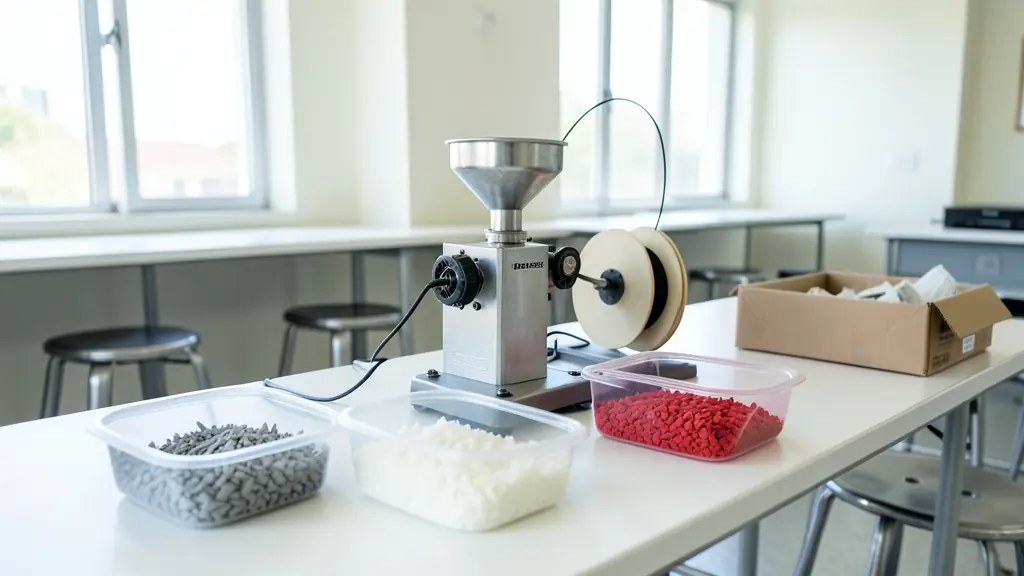
Every printer makes rubbish: supports, brims, purge blobs, a bracket printed three times before it fitted. A school with ten machines can fill a black bag a term, and a print farm in Midrand throws out kilos a month. Turning that waste back into filament is possible at home or in a lab, but it is a small factory process, not a kitchen trick. This page walks through the steps, where they go wrong, and when buying recycled spools from a specialist maker is the better plan.
Sort first, or do not bother
A spool made from mixed plastics prints like a mystery. PLA melts well below PETG, ABS and PLA do not bond, and a single piece of nylon can block a nozzle. Keep a labelled bin per material next to the printers, and a separate one for anything you are not sure of.
Colour matters too. Mixed colours come out a murky brown or grey, which is fine for jigs and internal parts. If you want a usable colour, sort by colour inside each material bin as well.
Shred, dry, extrude, wind
- Shred the parts into small flakes with a plastic shredder; large chunks feed unevenly.
- Dry the flakes, because they take on water fast with all that surface area. See filament dryers.
- Extrude them through a filament maker: a heated barrel and screw pushing plastic out of a die.
- Cool and measure the strand with a fan and a diameter sensor.
- Wind it onto a spool with a puller that sets the final thickness.
The diameter problem
Commercial spools hold around ±0.02 to ±0.05 mm on 1.75 mm filament; check any label. A home extruder drifts more than that as the flakes vary, and a thick spot jams the extruder gears while a thin one under extrudes. The fix is a puller that reads the diameter and changes speed, plus patience.
Expect the first few kilos to go back in the shredder. Recycled filament is also a little weaker each time it is melted, so use it for prototypes and fixtures before parts that matter. Weigh what you make with the filament length calculator.
What stays out of the hopper
- Resin prints and supports: cured resin is a thermoset and will not melt again.
- Parts glued from two materials, or with metal inserts and magnets.
- Carbon fibre and glass filled grades, unless your extruder is built for abrasives.
- Painted or coated prints.
For small volumes, buying recycled spools from a maker that does this properly often beats running the line yourself. Compare them on 3D printer filament.
What to put in your request
- Recycled spools, equipment, or a home for waste
- The material: PETG, PLA or another
- Roughly how many kilos you use or throw away
- The diameter tolerance you need
- Where you are and whether you can drop off waste
Filament Recycling for makers, schools, engineers and businesses
- Makers and hobbyists: a bin of failed prints turned into grey spools for test parts and jigs
- Schools, colleges and makerspaces: a recycling project where learners sort, shred and extrude the class's waste
- Engineers and product designers: recycled spools for early prototypes that will be printed again many times
- Small businesses and sellers: a print farm cutting waste and offering a recycled spool option to clients
- Factories, mines and workshops: sorted factory print waste extruded for fixtures that never leave the floor
- Dental labs and clinics: recycled spools kept to packaging and storage aids, never patient contact items
- Car owners and panel shops: recycled PETG for mock up brackets and fit check parts before the final ASA
- Architects, artists and prop makers: speckled recycled spools for planters, art pieces and décor with a story