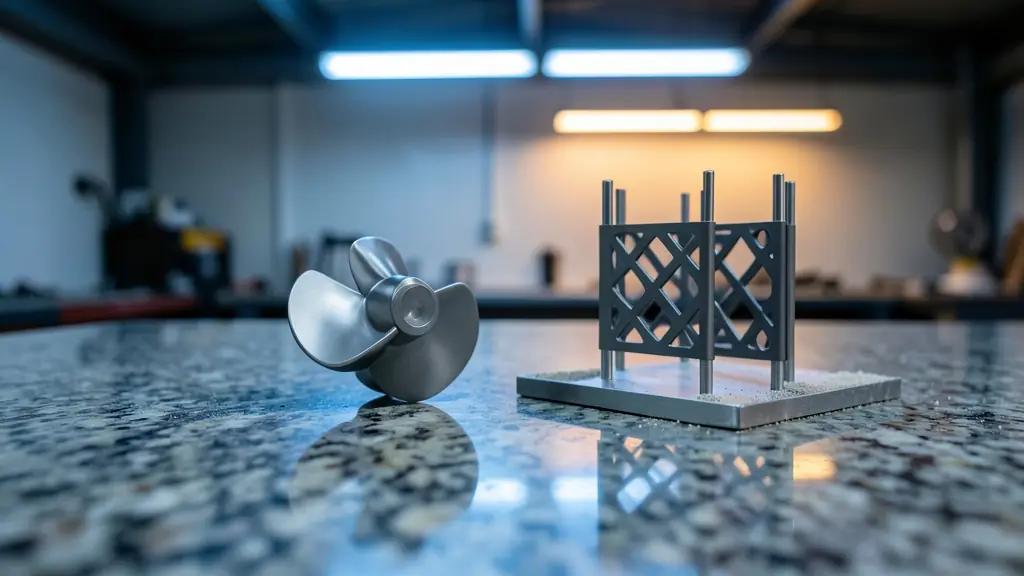
Few people in South Africa own a metal printer; nearly all metal parts come from a bureau running powder bed machines that cost as much as a house. That shapes everything about the job: you send a file, the bureau quotes per part, and the part arrives needing heat treatment, support removal and often machining before it does its work. Metal printing earns its price on shapes a lathe and mill cannot reach, short runs, and spares that would take months to import.
The routes to a metal part
- DMLS or SLM (powder bed fusion of metal): a laser melts fine powder layer by layer. Stainless steel such as 316L, titanium, aluminium alloys and tool steels. Dense parts, the most common bureau process.
- Binder jetting: powder glued into shape, then sintered in a furnace. Cheaper for batches of small parts; the part shrinks in the furnace, which the bureau allows for.
- Metal filled filament: printed on an FDM machine, then debound and sintered. A low cost way to small, simple parts if a bureau offers the sintering step.
- A printed pattern for casting: a resin or PLA pattern that a foundry burns out, covered below.
Why the price looks the way it does
The bureau prices the volume of metal in cm³, the height of the build (taller means more layers and more hours), and the support structure. Supports in metal are welded to the part and cut off by hand or wire, so a shape that needs fewer of them is cheaper.
Then come stress relief in a furnace, removing the part from the plate, blasting, and machining any face that must seal or hold a tolerance. Ask for these as separate lines. A quote for "printing" alone may be half the real cost. For the plastic side of costing, see 3D printing prices.
When casting from a print is cheaper
For a brass door handle, a bronze plaque, a run of jewellery or an aluminium bracket that does not need a laser fused structure, a foundry casting from a printed pattern usually costs far less. A resin printer makes fine patterns; see resin printers for that kit.
Choose powder bed fusion when the inside is the point: cooling channels in a mould insert, a lattice to save weight, or a manifold with curved passages that no drill could follow.
Steps before you order
- Send a STEP file, not just an STL, so the bureau can add machining allowance.
- Name the alloy and the condition you need after heat treatment.
- Mark the faces that need machining and their tolerance.
- Say what the part does, and have an engineer approve any load bearing use.
- Ask for a material certificate if your client or the mine requires one.
What to put in your request
- A STEP file with critical faces marked
- The alloy, such as 316L, titanium or aluminium
- How many parts and by when
- Machining, heat treatment and finish needed
- Whether you need a material certificate
Metal 3D Printing for makers, schools, engineers and businesses
- Makers and hobbyists: a one off stainless knife guard or bike part, usually as a cast from a printed pattern
- Schools, colleges and makerspaces: university engineering projects comparing printed alloy samples with machined ones
- Engineers and product designers: manifolds, lattices and lightweight brackets that a mill cannot shape in one piece
- Small businesses and sellers: small runs of stainless fittings or branded hardware too complex to machine cheaply
- Factories, mines and workshops: pump impellers, spray nozzles and wear parts for plants waiting on imported spares
- Dental labs and clinics: instrument prototypes for medical engineering firms that hold their own approvals
- Car owners and panel shops: motorsport brackets, turbo flanges and intake parts with an engineer's sign off
- Architects, artists and prop makers: jewellery and sculpture cast from printed patterns, or printed directly in steel