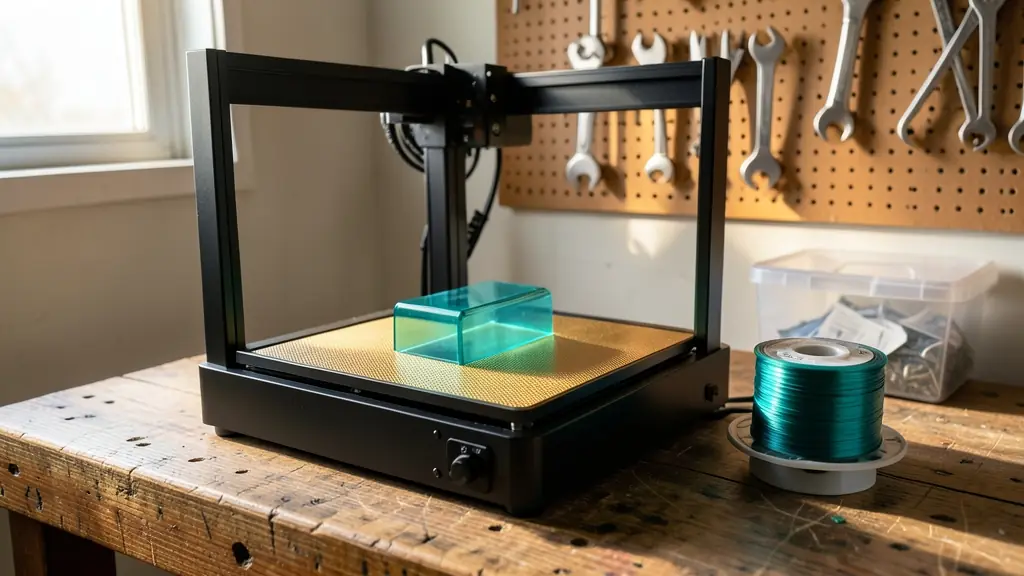
Your PLA bracket on the stoep sagged by February, or the clip you printed for the cupboard snapped the first time it flexed. That is usually when people buy their first spool of PETG. It takes more heat and far more sun than PLA, bends a little before it breaks, comes off the bed with a glossy face and barely smells in a spare room. It has three habits to learn: it strings, it can weld itself to a smooth bed, and it wants a slower first layer.
Jobs where PETG beats PLA
- Brackets and wall mounts in a garage or a roof space that bakes in summer.
- Outdoor clips: hose guides, shade net hooks, gate latch covers. For a part in full sun for years, ASA lasts longer.
- Plant pots and seedling trays that get watered every day on a balcony.
- Storage boxes, drawer dividers and parts bins that get knocked about.
If the part lives indoors, stays cool and needs crisp detail, plain PLA is still easier.
Stringing, sorted by what you see
- Fine hairs between two towers: retraction too short or too slow. Run a retraction test in the slicer and change one value at a time.
- Popping and tiny bubbles at the nozzle: a wet spool. Dry it before you touch any setting; see filament dryers.
- Blobs on the outer wall: the nozzle runs hot. Drop it 5 °C.
- Fine one week, hairy the next: the spool sat on the printer through a damp Cape winter and took moisture back.
The first layer, and getting the part off again
PETG grabs a smooth PEI sheet so hard it can pull flakes out of the coating when you flex the plate. Wipe on a thin film of glue stick as a release layer, or print on textured PEI, which lets go once cool. More on surfaces under build plates.
Do not squash the first layer the way you would with PLA. Lift the nozzle a hair, slow that layer right down and let the bed reach its heat. Typical ranges are a nozzle of 230 to 250 °C and a bed of 70 to 85 °C; the print settings guide has the rest, and the spool label wins.
A routine for every new PETG spool
- Read the label: diameter tolerance, nozzle and bed range, drying advice.
- If the bag was open or you live near the coast, dry it for a few hours.
- Print a temperature tower and pick the coolest layer that still bonds well.
- Run a short retraction test.
- Set the first layer with glue stick on smooth sheets.
- Store it sealed with desiccant between jobs.
PETG is a little denser than PLA, so a kilogram gives slightly fewer metres; the filament length calculator shows how many.
What to put in your request
- How many kilograms you need and on what spool size
- The colours, and whether you want clear or solid
- The filament diameter your printer takes
- What you will print, so the supplier can suggest a grade
- Your town and when you need the spools
PETG Filament for makers, schools, engineers and businesses
- Makers and hobbyists: shelf brackets, hose clips, garden labels and storage bins that outlast a PLA version
- Schools, colleges and makerspaces: robotics chassis parts and project boxes that survive being dropped off the desk
- Engineers and product designers: functional prototypes and snap fit housings that need to flex without cracking
- Small businesses and sellers: shop display stands, cable organisers and durable products for sale at markets
- Factories, mines and workshops: machine guards, label holders and cable guides for a factory floor
- Dental labs and clinics: tool trays and storage holders for a clinic, never a device or anything worn
- Car owners and panel shops: boot organisers, cup holder inserts and clips in shaded parts of the cabin
- Architects, artists and prop makers: translucent lamp shades and architectural pieces that sit near a warm light