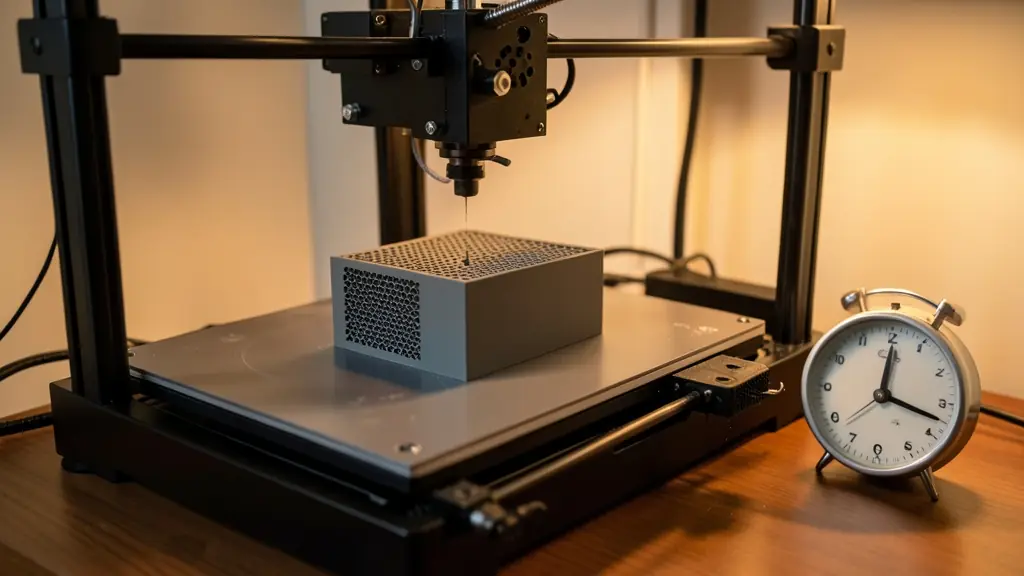
Before anyone has drawn the part, you still want to know: is this a two hour print or an overnight one, 40 g or 400 g? This estimator works it out from the outside size. It counts the walls and the top and bottom skins as solid, fills the inside at your infill and divides by how much plastic a printer pushes out an hour. Once there is a file, a slicer does better. Bureaus quote on 3D printing services.
How the estimate is built
- Shell: the outside area times 1.2 mm of solid wall, about three lines of a 0.4 mm nozzle.
- Skin: 0.8 mm solid at the top and bottom.
- Infill: the rest of the inside at 10%, 20%, 40% or 100%.
- Grams: that volume times the material's density.
- Hours: volume divided by an average flow of 10 mm³/s for a normal printer or 20 mm³/s for a fast core XY machine, plus 20% for travel, retraction and heating up.
All of these are our defaults, set below what hot ends manage at full speed because a printer slows for walls, corners and small layers. Change any of them in the tool.
Where it goes wrong
The tool assumes a box. A thin walled vase, a part full of holes or a curved helmet uses far less plastic than its outside size suggests, so the estimate runs high. Tall thin parts print slower than the volume says because each small layer has to cool before the next. Supports add 15% to the plastic by default when the part has overhangs, and more time again for removing them. A part printed several at a time on one plate saves heating time per part.
Layer height and nozzle
Halving the layer height roughly doubles the time on a normal printer, because the head makes twice the passes. A bigger nozzle does the opposite: a 0.6 mm nozzle with thicker layers can cut a big part's time a great deal at the cost of fine detail. Check what your hot end can feed with the nozzle flow calculator, and see 3D printer nozzles for sizes.
Sources
- Hot end maker, brass nozzle flow rates: standard flow, PLA at 220 °C: 0.4 mm 13, 0.6 mm 14, 0.8 mm 17 mm³/s
- Independent test lab blog, hot end flow rate benchmark: a V6 class hot end on PLA at 215 °C: about 10 to 15 mm³/s is the limit; skipping starts at 15
- Printer maker C, maximum volumetric speed guide: standard all metal V6 class 8 to 12; high flow hot ends 25 to 40; high flow nozzles 20 to 35; the maker's own extruder 15 to 20 mm³/s
- Printer maker B, slicer filament profile (PLA): maximum volumetric speed for its PLA on its enclosed core XY printer: 21 mm³/s with the standard hot end, 29 with the high flow one; generic PLA 12
- Printer maker B, volumetric speed explained: its PLA on a current core XY model is specified at 25 mm³/s; high flow 0.4 mm nozzle about 35, high flow 0.6 mm up to 40
- Printer maker B, layer height guide: a reasonable layer height is 20% to 70% of the nozzle diameter; 0.08 to 0.28 mm for a 0.4 mm nozzle
- Printer maker C, creating profiles for different nozzles: layer height at most 70 to 80% of the nozzle; extrusion width about 110% of the nozzle, and 1.125 x the nozzle when the width is left at 0
- Printer maker C blog, nozzles with a different diameter: 0.25 mm for fine detail, text and jewellery, much slower; 0.4 mm the default; 0.6 mm for parts without tiny detail, can roughly halve print time; 1.0 mm up to five times faster than 0.4 mm, usually at 0.5 mm layers, rough look
- Filament maker B, PLA technical data sheet: density 1.24 g/cm³; nozzle 190 to 230 °C; bed 35 to 45 °C (smooth cool plate); drying 55 °C for 8 h; heat deflection 54 °C at 1.8 MPa, 57 °C at 0.45 MPa; Vicat 57 °C
- Filament maker A, technical data at a glance (summary table): density and heat deflection at 0.45 MPa: PLA 1.17 and 60 °C, PLA Pro 1.23 and 59 °C, PETG 1.25 and 78 °C, ABS 1.04 and 100 °C, ASA 1.13 and 103 °C, TPU95 1.22, PC 1.19 and 111 to 114 °C, silk PLA 1.24 (Vicat 64.7 °C); nylon 6 carbon fibre 1.17 and 215 °C annealed, nylon 12 carbon fibre 1.06 and 131 °C annealed
Frequently asked questions
How accurate is the print time estimate?
Why is a fast printer not twice as fast on every part?
Does more infill make a part much stronger?
Can a bureau quote on this part before I have a CAD file?
More calculators and tools
- 3D print cost calculatorFilament, electricity, machine wear and failures: the cost of one print
- Filament length calculatorGrams to metres and back, and how many parts one spool prints
- Resin calculatorMillilitres, grams, bottles and cost for resin prints
- Print settings guideNozzle, bed, drying and enclosure for each filament
- Will it fit calculatorPart size against printer build volumes, flat, on its side or diagonal
- Backup power calculatorBattery and inverter size to finish a print through load shedding
- Nozzle flow calculatorVolumetric flow from nozzle, layer, width and speed, against hot ends