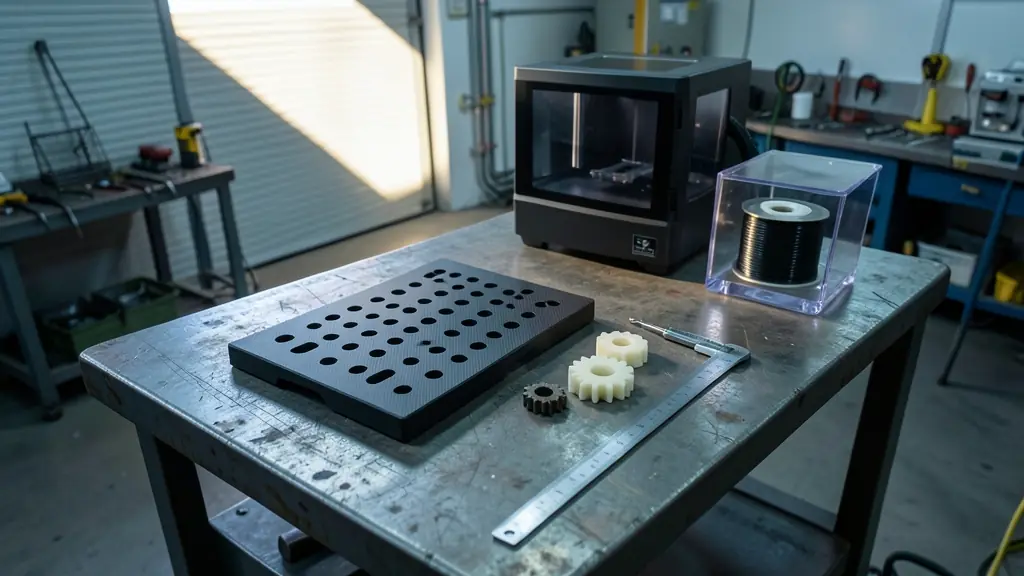
A conveyor guide wears through on a Rustenburg plant and the imported spare is six weeks out. A factory in Pinetown needs a drilling jig by Monday. That is where nylon, carbon fibre filled grades and polycarbonate come in: the engineering end of the filament shelf. Nylon brings wear resistance and toughness, carbon fibre fill brings stiffness and a matte finish, PC brings heat resistance. They ask more of the printer than PLA ever does and punish a wet spool. Whether a printed part may carry a load is for an engineer to decide.
Three materials, three kinds of job
- Nylon (PA): tough, slightly slippery and wear resistant. Gears, bushes, wear strips, hinges, clips that flex thousands of times.
- Carbon fibre filled (PA-CF, also PETG-CF): short chopped fibres make it stiff and dimensionally steady with a matte face. Jigs, fixtures, brackets, drone frames. It is less forgiving under impact than plain nylon.
- Polycarbonate (PC): hard and heat resistant, printed at typically 260 to 300 °C, and it warps without an enclosure.
Drying is part of the print
Nylon pulls water out of the air within hours on a humid day. A wet spool foams at the nozzle, strings, and gives weak, rough parts that look printed in a hurry. Dry it at roughly 60 to 80 °C for several hours, as the label says, and print straight from a heated or sealed dry box. See filament dryers.
The finished part takes on moisture too and its feel changes a little over the following days, so test it in the conditions where it will work, not fresh off the bed.
What the printer needs
- A hardened steel or tipped nozzle. Carbon fibre wears brass fast and the holes grow; see nozzles.
- An all metal hot end that runs nylon's 250 to 280 °C and up without damage.
- A 0.6 mm nozzle, which clogs less with fibre filled grades.
- An enclosure for PA and PC, and a bed sheet or adhesive the spool maker suggests.
Before a printed spare goes into service
- Start from the original part or a drawing with its dimensions. No file? Ask for CAD design.
- Print one and check the fit on the machine before printing a set.
- Have an engineer sign off any part that carries a load or protects a person.
- Mark the printed part and log the date, so the workshop knows it is a stopgap.
- Keep the file for the next time it wears out.
For a batch or a more even part, a bureau can print SLS nylon; see printing services.
What to put in your request
- Which material: nylon, carbon fibre filled or PC
- What the part does and where it works
- Your printer's maximum nozzle temperature
- Whether you have a hardened nozzle and dryer
- How many kilograms and how soon
Nylon and Carbon Fibre Filament for makers, schools, engineers and businesses
- Makers and hobbyists: drone frames, tool holders and gears for a home workshop that sees real wear
- Schools, colleges and makerspaces: university engineering projects and robotics parts that need stiffness and wear resistance
- Engineers and product designers: jigs, fixtures and functional prototypes tested before machining or moulding
- Small businesses and sellers: short runs of tough brackets and fittings sold to trades and installers
- Factories, mines and workshops: stopgap mine and factory spares, guides and wear strips while imports arrive
- Dental labs and clinics: workshop jigs and holders in an orthotic lab, never a part worn by a patient
- Car owners and panel shops: motorsport ducts, brackets near heat and spacers, never brakes or steering
- Architects, artists and prop makers: rigid camera rigs, stage hardware and props that carry repeated handling